
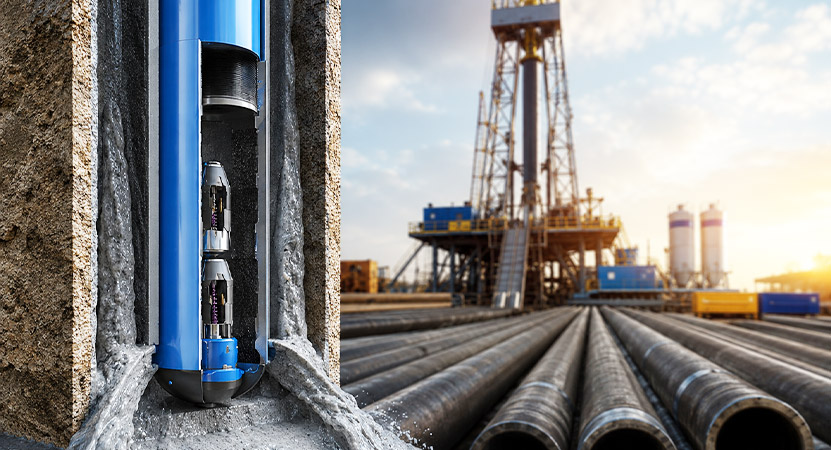
A float shoe is an important component of casing and primary cementing equipment used in oil and gas well construction. Installed at the bottom of a casing string, a float shoe helps guide the casing into the wellbore while its internal check-valve system controls fluid movement during casing running and cementing operations.
During primary cementing, cement slurry is pumped down through the casing and exits through the bottom of the casing assembly into the annulus. The float shoe is designed to allow fluid movement in the intended direction while helping prevent reverse flow after pumping and displacement operations. This backflow-control function is one of the key reasons float shoes are widely used as part of casing cementing systems.
Float shoes are available in different configurations to accommodate varying well conditions, casing sizes and cementing requirements. Common configurations include single-valve and double-valve designs, while specialized float equipment can include stab-in, auto-fill and other application-specific configurations. Emson Oil Tools currently offers float shoes with single- and double-valve configurations and positions them for vertical, horizontal and deviated well applications.
This guide explains what a float shoe is, how it works, its construction, major types, applications, differences from related casing equipment, important selection factors and considerations for oilfield procurement teams.
A float shoe is a casing accessory installed at the lower end of a casing string. It combines a shaped shoe profile for guiding the casing with a check-valve mechanism that controls fluid movement through the casing during well construction and cementing.
In a conventional casing arrangement, the float shoe forms part of the lower casing assembly. As the casing is run into the well, the shoe helps the casing string pass through the wellbore. During cementing, cement is pumped through the casing and exits through the float shoe into the annulus. The check valve then helps prevent cement or other fluids from flowing back into the casing when the pressure conditions change.
The float shoe therefore performs two closely related functions:
This combination makes the float shoe an important part of the casing and cementing system.
A typical casing shoe track may contain a float shoe at the bottom, a section of casing above it and a float collar positioned farther up the string. The exact arrangement depends on the casing design and cementing program.
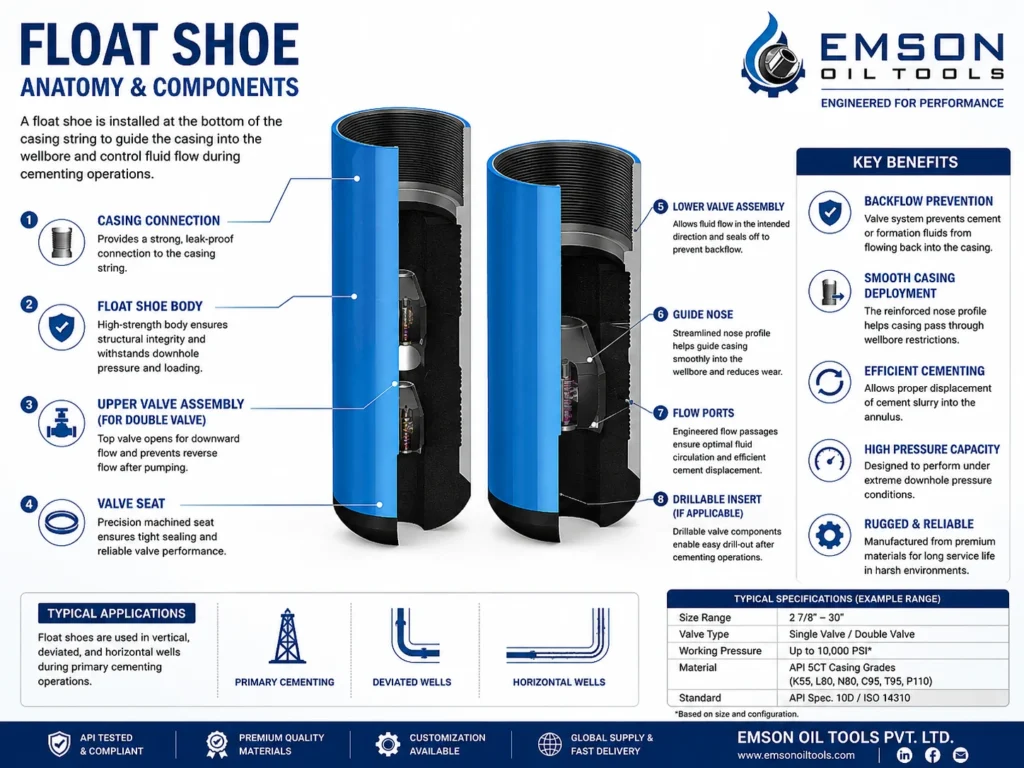
Understanding how a float shoe works requires looking at the complete casing and cementing sequence rather than the component in isolation.
1. Float Shoe Installation
The float shoe is connected to the bottom of the casing string before the casing is run into the well.
Its connection must match the casing and the specified casing assembly. The shoe profile is designed to assist the casing in passing through the wellbore.
2. Casing Is Run Into the Well
As the casing is lowered, the float shoe leads the casing string.
The rounded or streamlined lower profile helps the casing move through the wellbore and reduces the tendency for the casing end to catch on certain wellbore irregularities.
Float equipment can also contribute to reducing the effective load associated with running casing by controlling how the casing fills with wellbore fluid, depending on the equipment configuration and running procedure.
3. Cement Is Pumped Through the Casing
Once the casing reaches the required depth and the cementing operation begins, cement slurry is pumped down through the casing.
The fluid travels through the casing and reaches the float equipment at the bottom of the casing string.
4. Cement Passes Through the Float Shoe
The float shoe’s valve arrangement permits flow in the intended direction during cement displacement.
The cement then exits the lower casing assembly and moves into the annular space between the casing and the wellbore or previous casing string.
5. The Valve Helps Prevent Backflow
Once pumping and displacement conditions change, the check-valve mechanism helps prevent fluid from flowing back through the float shoe into the casing.
This is an important function because uncontrolled reverse flow can interfere with cement placement and the intended cementing program.
6. Cement Remains Positioned in the Annulus
The objective of the cementing operation is to place cement in the planned annular interval and establish the required barrier and zonal-isolation characteristics.
The float shoe works as one component within this larger cementing system.
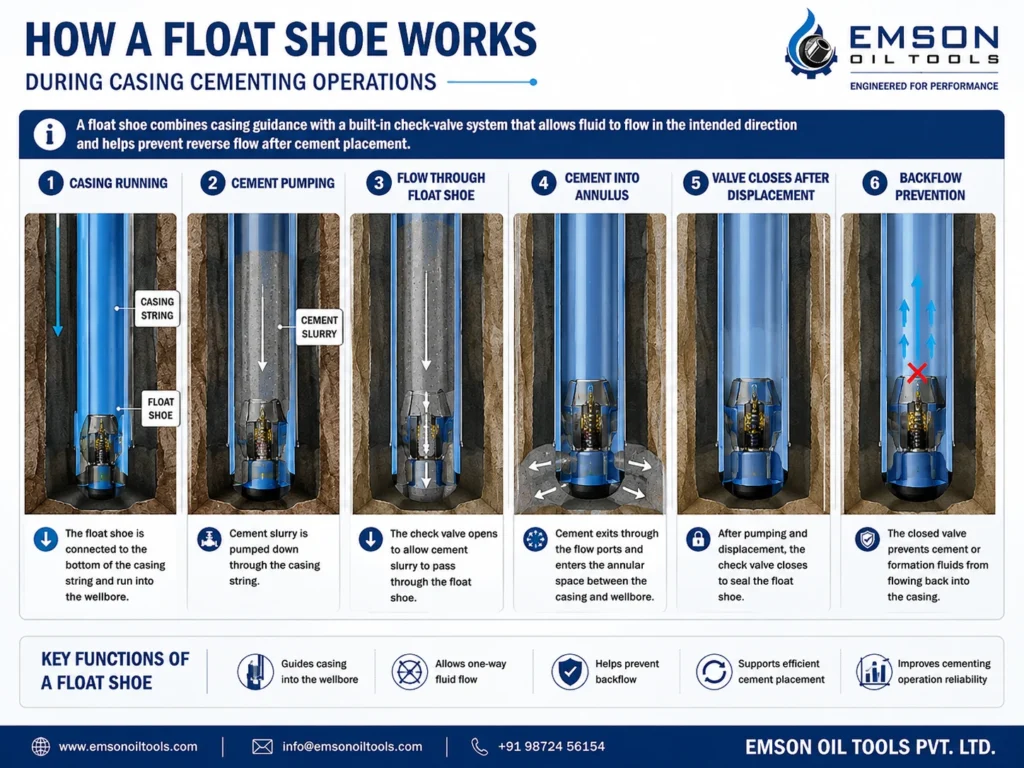
The exact construction of a float shoe varies according to its design and application, but a typical assembly can include several important components.
Float Shoe Body:
The body forms the primary structural housing of the equipment and provides the connection between the casing string and the lower shoe assembly.
The body must be suitable for the intended casing and operating conditions.
Valve Assembly:
The valve is the functional heart of the float shoe.
It controls fluid movement through the shoe and provides the one-way flow characteristic required during cementing.
Emson’s current float shoe range uses a plunger-valve design and offers single- and double-valve configurations.
Valve-Sealing Components
The valve assembly requires appropriate sealing components to maintain the required fluid-control function.
Depending on the design, these may include polymeric, elastomeric or other engineered components.
The exact material selection should be based on the manufacturer’s technical design and the operating environment.
Nose / Shoe Profile
The lower profile of the shoe assists casing movement through the wellbore.
The geometry may differ depending on whether the product is intended primarily as a conventional float shoe or incorporates additional features for more challenging wellbore conditions.
Casing Connection
The connection provides the mechanical interface between the float shoe and casing.
Thread type and dimensions should be matched to the casing specification and customer requirement.
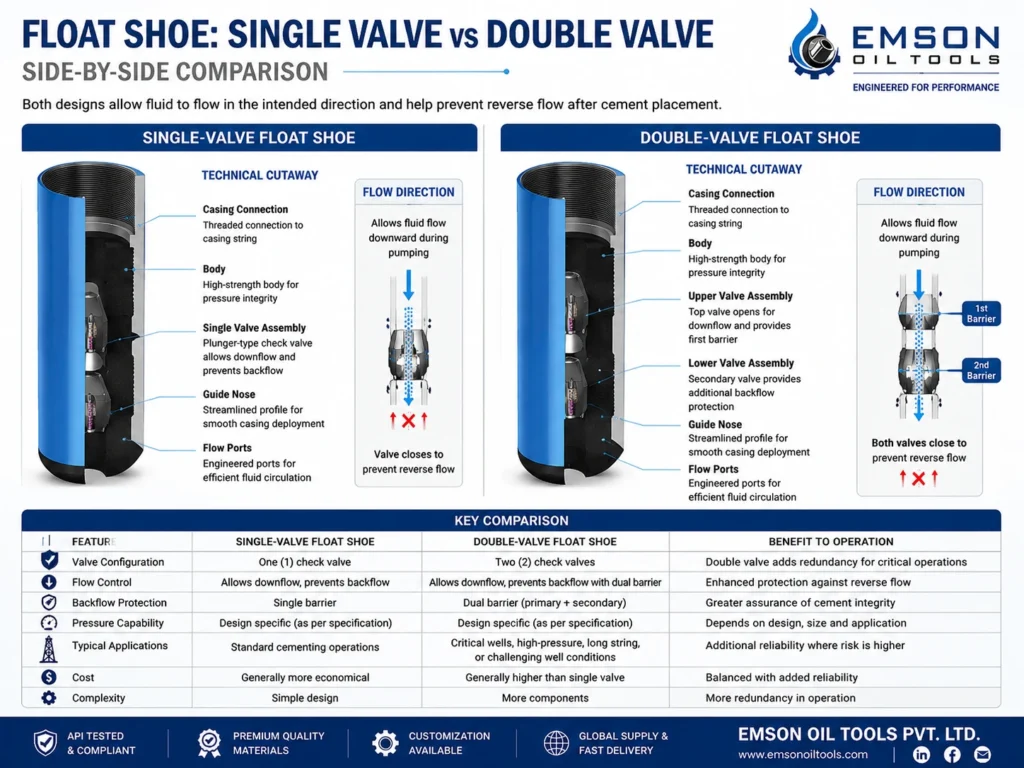
Float shoes are available in multiple configurations. The appropriate design depends on the casing program, well conditions and cementing method.
Single-Valve Float Shoe
A single-valve float shoe incorporates one primary check-valve mechanism.
Its basic operating principle is to allow fluid to move through the casing and shoe in the intended direction while helping prevent reverse flow.
Single-valve configurations can be appropriate for conventional casing and cementing applications where the specified performance requirements can be met with one valve.
Double-Valve Float Shoe
A double-valve float shoe incorporates two valve elements.
One reason for using multiple valves is redundancy: if one valve does not establish the required seal, the second valve provides an additional barrier. However, the presence of two valves should not automatically be interpreted as meaning that the product has twice the pressure rating or twice the durability. The actual performance depends on the complete design and applicable specifications.
Double-valve designs can therefore be considered where additional valve redundancy is desirable.
Stab-In Float Shoe
Stab-in float equipment is used in specialized cementing arrangements where the drill pipe or inner string is connected directly to the float equipment.
This configuration can support particular cementing procedures, including applications involving large-diameter casing and inner-string cementing. Emson offers stab-in float shoe and collar equipment for such applications.
Auto-Fill Float Shoe
Auto-fill designs allow casing to fill with fluid during casing deployment according to the operating principle of the particular tool.
This can be useful where casing-running procedures require controlled internal filling and reduced pressure differential during deployment.
Emson currently lists auto-fill float shoe and collar equipment within its float-equipment range.
| Feature | Single-Valve Float Shoe | Double-Valve Float Shoe |
|---|---|---|
| Valve configuration | One valve | Two valves |
| Primary purpose | One-way fluid control | One-way fluid control with additional valve redundancy |
| Typical consideration | Conventional applications | Applications where additional redundancy is desired |
| Flow direction | Controlled through valve design | Controlled through valve design |
| Selection basis | Well and cementing program | Well and cementing program |
| Pressure performance | Design-specific | Design-specific |
| Availability | Common configuration | Common configuration |
Important: Valve count alone should not be used as the only basis for product selection. The casing program, pressure conditions, cementing procedure, well geometry and manufacturer’s technical specifications should all be considered.
Float shoe and float collar are closely related components and are often used together, but they do not occupy the same position or perform exactly the same role in a casing assembly.
The float shoe is installed at the bottom of the casing string, whereas the float collar is installed farther up the casing string, commonly above the float shoe as part of the shoe-track arrangement. The float collar also provides a landing point for cementing plugs in conventional cementing systems.
| Feature | Float Shoe | Float Collar |
| Typical location | Bottom of casing string | Above float shoe |
| Main role | Guides casing and controls fluid flow | Controls fluid flow and provides plug landing function |
| Check valve | Yes, depending on design | Yes |
| Casing guidance | Primary function | Not primary function |
| Cement plug landing | Not normally its primary role | Important function |
| Typical use | Casing running and cementing | Cementing and backflow control |
| Shoe-track position | Bottom | Above shoe |
The two components should therefore be considered complementary rather than interchangeable.
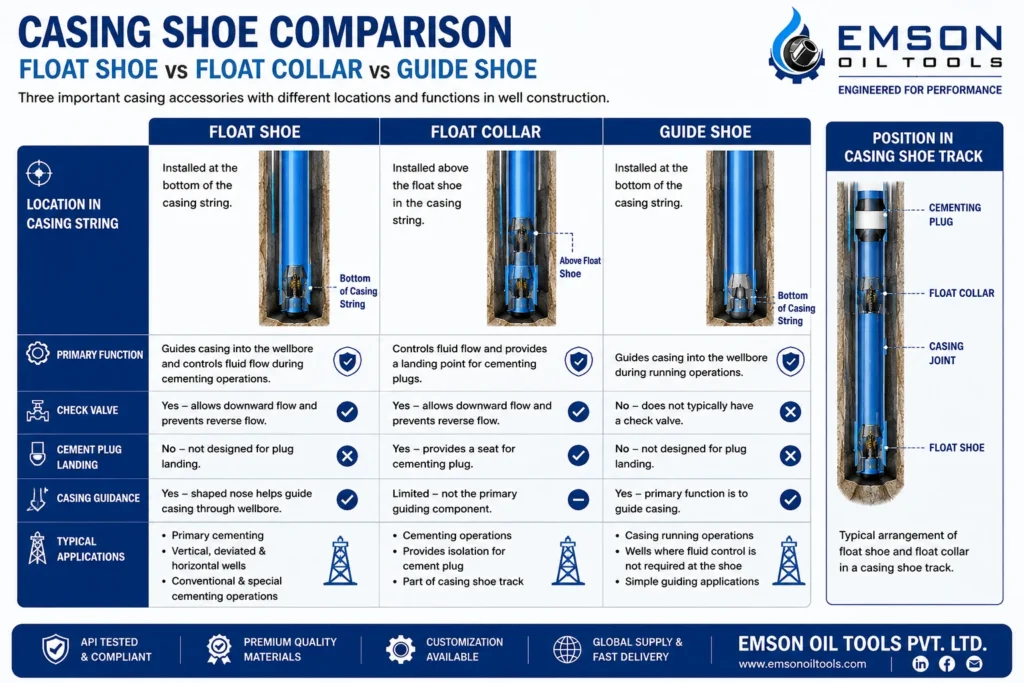
A guide shoe and a float shoe can appear similar because both are installed at the lower end of casing and can help guide the casing through the wellbore.
The major distinction is the fluid-control function.
A float shoe incorporates a check valve designed to provide controlled one-way fluid movement. A conventional guide shoe is primarily intended to guide casing and does not necessarily provide the same backflow-control function.
This distinction is important when selecting casing equipment because the correct product depends on the cementing program and required fluid-control function.
Float shoes are used across a range of casing and cementing applications.
Primary Casing Cementing
One of the most common applications is primary cementing.
During primary cementing, cement is pumped through the casing and displaced through the lower casing assembly into the annulus. The float shoe supports controlled fluid movement and helps prevent cement from flowing back into the casing after placement.
Vertical Wells
Float shoes are commonly used in conventional vertical well construction.
The shoe provides a guided lower profile for casing deployment while the valve mechanism supports the cementing operation.
Deviated Wells
Casing deployment can become more challenging as well deviation increases.
Float shoe selection in deviated wells may therefore require consideration of shoe profile, casing movement, wellbore geometry, friction and the specific running procedure.
Emson identifies its float shoes for vertical, horizontal and deviated well applications.
Horizontal Wells
Horizontal and highly deviated well sections can introduce additional casing-running and cement-placement considerations.
The appropriate float equipment should be selected according to the casing design, well trajectory and cementing requirements.
Large-Diameter Casing
Specialized float equipment configurations can be used in large-diameter casing applications, including inner-string cementing arrangements.
Challenging Wellbore Conditions
Where casing has to pass through complex wellbore geometry, equipment selection may involve specialized shoe designs such as reamer shoes or other casing-running solutions.
A conventional float shoe may not be the appropriate choice for every difficult wellbore condition, which is why the complete application should be evaluated before selecting the product.
A correctly selected float shoe can support several aspects of casing and cementing operations.
Controlled Fluid Movement: The check valve helps control fluid movement through the lower casing assembly.
Backflow Prevention: The valve helps prevent cement slurry from flowing back into the casing after displacement.
Casing Guidance: The shoe profile helps guide the lower end of the casing through the wellbore.
Support for Cementing Operations: The float shoe provides the flow path through which cement can leave the casing and enter the annulus.
Reduced Operational Risk: Appropriate float equipment can contribute to more controlled casing and cementing operations when properly matched to the well program.
Compatibility With Different Well Geometries: Float shoe designs are available for a range of casing and well applications, including vertical, deviated and horizontal wells.
Float shoes should be selected according to the actual casing and cementing requirements.
A typical procurement specification may include the following information:
| Specification | What to Consider |
| Product type | Single valve, double valve or specialized configuration |
| Casing size | Required casing outside diameter |
| Casing grade | Compatibility with casing specification |
| Connection | Required casing connection/thread |
| Valve configuration | Single or double valve |
| Well type | Vertical, deviated or horizontal |
| Pressure conditions | Required pressure performance |
| Temperature | Applicable downhole temperature |
| Cementing method | Conventional, inner-string or other method |
| Flow requirements | Required circulation/displacement characteristics |
| Drill-out requirements | Drillable internal components where applicable |
| Customization | Application-specific requirements |
| Applicable standards | Customer/project requirements |
Emson’s current float shoe page lists sizes from 2 7/8 inches to 30 inches, multiple casing steel grades including K-55, L-80, N-80, C-95, T-95 and P110, a plunger-valve design and customization upon request. The page also states that the products are tested according to API specifications. These details should be reconfirmed against the latest product datasheet before publication or quotation.
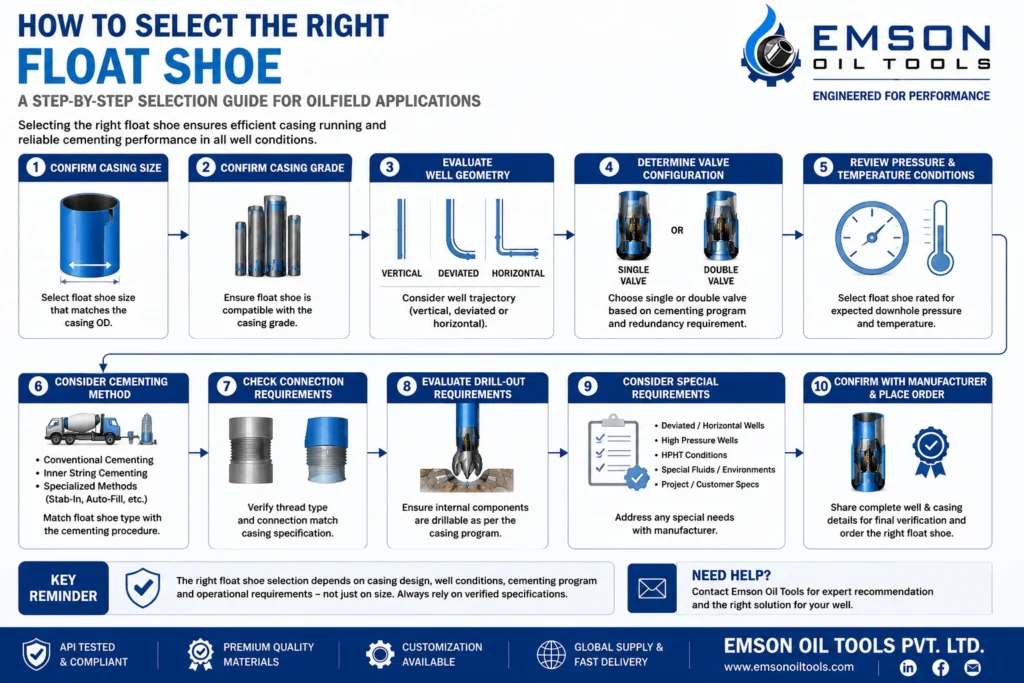
Selecting a float shoe should begin with the well and casing program, not simply the keyword or product name.
1. Confirm Casing Size: The first requirement is the casing size for which the float shoe will be used. The shoe connection and dimensions must be compatible with the casing assembly.
2. Confirm Casing Grade: The float shoe body and connection must be suitable for the casing specification and operating requirements.
3. Evaluate Well Geometry: Determine whether the application is:
The well trajectory can influence casing-running requirements and shoe selection.
4. Determine Valve Configuration: Decide whether a single-valve or double-valve design is appropriate for the cementing program. If redundancy is important, a double-valve configuration may be considered.
5. Review Pressure Conditions: The float shoe should be suitable for the expected pressure conditions. Pressure requirements should be evaluated using the manufacturer’s verified technical ratings rather than assumptions based only on the product name.
6. Consider Cementing Procedure: The cementing method is another important factor. Conventional casing cementing and specialized methods such as inner-string cementing may require different float-equipment configurations.
7. Consider Drill-Out Requirements: If the shoe track will be drilled out after cementing, the internal design and drillability of the equipment should be considered.
8. Confirm Connection Requirements: The connection should correspond to the casing and project specification.
9. Consider Custom Requirements: For non-standard casing, unusual well conditions or specialized cementing programs, discuss the application with the manufacturer before ordering.
A float shoe is only one component within a larger casing and cementing system. Its performance depends on correct selection, installation and operation.
Before installation, verify:
The casing assembly should be handled carefully to prevent damage to the connection, valve system or sealing components.
During the cementing operation, the float equipment should be operated according to the approved cementing program and applicable field procedures.
For specialized equipment, such as stab-in or auto-fill configurations, the operating procedure can differ from conventional float equipment. The manufacturer should provide the appropriate operating information for the selected configuration.
Selecting the correct float shoe is not simply a matter of matching nominal casing size.
Several common mistakes can create unnecessary operational risk.
Choosing Only by Casing Size: Casing size is important, but it is not the only requirement. Valve configuration, connection, pressure conditions and cementing procedure must also be evaluated.
Ignoring Well Geometry: A shoe suitable for a straightforward vertical well may not automatically be the best choice for a highly deviated or horizontal application.
Treating Single and Double Valves as Interchangeable: The choice between single and double valves should be based on the actual cementing program and required redundancy.
Not Confirming Thread/Connection: A dimensional mismatch between casing and float equipment can make the product unsuitable for the intended application.
Selecting Without Reviewing the Cementing Program: The float shoe should be evaluated as part of the complete shoe-track and cementing system.
Assuming Every Float Shoe Has the Same Performance: Different designs, valve systems, materials and manufacturing configurations can have significantly different operating characteristics.
A float shoe should not be evaluated completely independently from the rest of the shoe-track arrangement.
A conventional arrangement can include:
Casing String → Float Collar → Casing Joint(s) → Float Shoe
The exact configuration varies by casing and cementing program.
The float collar can provide an additional check valve and a landing point for cementing plugs, while the float shoe remains at the bottom of the casing string.
This arrangement creates a coordinated system for casing deployment, cement displacement and backflow control.
Float equipment performs a critical function within the casing and cementing system, so product quality and consistency are important considerations for oilfield buyers.
The manufacturing process should maintain the required dimensional accuracy and functional characteristics of the valve and casing connection.
Important procurement considerations include:
For international procurement, buyers should request the relevant product datasheet, drawings, specifications and quality documentation before finalizing an order.
When purchasing float shoes, oilfield operators, drilling contractors, cementing service companies and distributors typically require more than a standard product description.
A reliable supplier should be able to understand the application and provide the appropriate configuration based on:
Emson Oil Tools is positioned as an oilfield equipment manufacturer and global supplier, with float equipment included within its product portfolio. Its current float-equipment range includes float shoes, float collars, stab-in configurations, auto-fill equipment, reamer shoes and guide shoes.
The company’s current Float Shoe product information identifies single- and double-valve configurations and describes applications across vertical, horizontal and deviated wells. It also provides product size, material and valve information for procurement reference.
For a specific casing program, buyers should provide the required casing size, grade, connection and operating conditions so that the appropriate float shoe configuration can be evaluated.
For an international oilfield buyer, selecting a float shoe supplier should involve both product capability and technical communication.
Emson’s float-equipment portfolio covers multiple casing and cementing configurations, allowing buyers to evaluate conventional and specialized float equipment within the same product range.
The Float Shoe range currently includes single- and double-valve configurations, with published product information covering casing sizes, casing steel grades, valve design, application environments and customization availability.
For project-specific requirements, buyers can provide their casing and cementing specifications to determine the appropriate product configuration.
Looking for a Float Shoe for your next casing or cementing operation?
Contact Emson Oil Tools with your:
The technical team can then evaluate the appropriate float shoe configuration for the application.
1. What is a float shoe in oilfield cementing?
A float shoe is a casing accessory installed at the bottom of the casing string. It helps guide casing into the wellbore and incorporates a check-valve mechanism that controls fluid movement during cementing and helps prevent backflow after cement placement.
2. What is the main purpose of a float shoe?
The primary functions of a float shoe are to help guide casing during deployment and provide controlled one-way fluid movement during cementing. Its valve helps prevent cement or other fluids from flowing back into the casing.
3. Where is a float shoe installed?
A float shoe is normally installed at the bottom of the casing string. It forms the lower end of the casing shoe-track assembly.
4. What is the difference between a float shoe and a float collar?
A float shoe is installed at the bottom of the casing and combines casing guidance with fluid-control functionality. A float collar is installed farther up the casing string and generally provides a check valve and a landing point for cementing plugs.
5. What is the difference between a float shoe and a guide shoe?
A float shoe includes a check-valve system for fluid control, whereas a conventional guide shoe primarily provides casing guidance. The appropriate choice depends on the casing and cementing program.
6. What are single-valve and double-valve float shoes?
A single-valve float shoe uses one check valve, while a double-valve float shoe uses two valve elements. A double-valve configuration can provide additional redundancy, but the actual performance depends on the complete equipment design and specifications.
7. Can float shoes be used in horizontal wells?
Yes. Float shoes are available for different well geometries, including vertical, deviated and horizontal applications. The specific design should be selected according to the casing program and well conditions.
8. What sizes of float shoes are available?
Availability depends on the manufacturer and configuration. Emson’s current Float Shoe product information lists sizes from 2 7/8 inches to 30 inches, with customization available upon request. Buyers should confirm the required size and configuration for their specific project.
9. What information should I provide when requesting a float shoe quotation?
A useful RFQ should include casing size, casing grade, connection, required valve configuration, well type, operating conditions, quantity and delivery requirements. Drawings or project specifications can also help the manufacturer recommend the appropriate configuration.
10. Can float shoes be customized?
Customization may be available depending on the manufacturer and application. Emson currently states that customization is available upon request for its Float Shoe range. Specific requirements should be discussed with the manufacturer before ordering.
Float shoes are normally considered as part of a broader casing and cementing equipment system.
Explore related equipment such as:
Internal links from this article should connect directly to the relevant Emson product and category pages. This creates a clear relationship between float equipment, casing accessories and cementing equipment while helping users move from technical research to product evaluation.
Choosing the correct float shoe is an important part of planning a reliable casing and cementing operation.
Whether you require a conventional single-valve float shoe, double-valve configuration or a specialized float-equipment solution, the selection should be based on the casing design, well conditions and cementing procedure.
Need an oilfield float shoe for your project?
Send Emson Oil Tools your casing and application requirements to discuss the appropriate product configuration.
Copyright © 2020 - Emson Oil Tools. All Right Reserved. | Privacy Policy | Terms & Conditions