
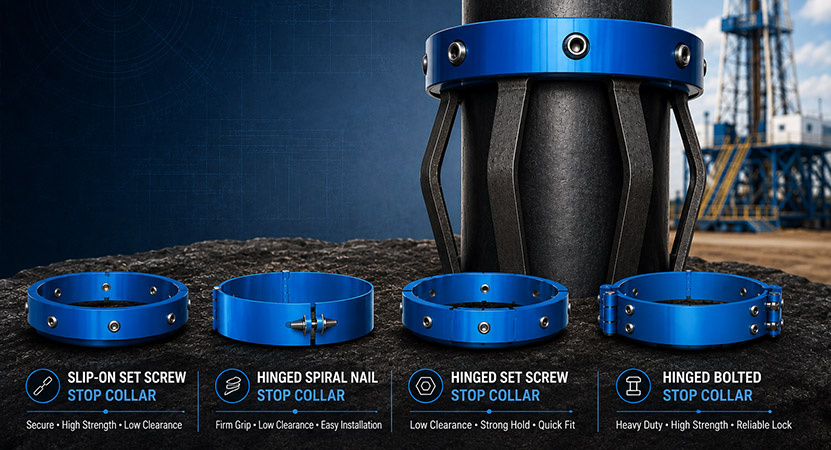
In oil and gas well construction, successful primary cementing depends on much more than the cement slurry itself. The casing string must be positioned correctly, centralizers must remain at their designed locations, and the annular space must allow effective mud displacement and cement placement.
A stop collar is a relatively small casing accessory that plays an important role in this process.
Installed on the casing string, a stop collar acts as a mechanical restraint for casing centralizers, cement baskets, scratchers, and other casing accessories. Its primary purpose is to prevent the accessory from moving axially away from its predetermined position during casing running and cementing. Baker Hughes describes stop collars as restraining devices that prevent centralizers from moving away from their predetermined casing positions.
This positioning is important because a centralizer can only provide the intended casing standoff if it remains where the casing design specifies it should be. If a centralizer moves during run-in-hole, the resulting change in standoff can affect casing centralization, fluid displacement and cement distribution.
Stop collars are available in several configurations, including slip-on set screw, hinged bolted, hinged set screw and hinged spiral nail designs. Emson Oil Tools currently manufactures these four configurations and lists sizes from 2⅞″ to 30″, with custom sizes available.
The correct stop collar depends on factors such as casing size, centralizer design, annular clearance, expected axial loads, installation method and well geometry.
This guide explains what a stop collar is, how it works, the different types, applications, installation considerations, the relationship between stop collars and centralizers, and how to select a suitable oilfield stop collar manufacturer or supplier.
A stop collar is a mechanical device installed around a casing string to restrict the axial movement of a casing accessory.
In oilfield casing operations, centralizers are positioned at specific intervals along the casing. Their job is to maintain an appropriate gap between the casing and the wellbore or previous casing string.
However, simply placing a centralizer on the casing does not necessarily guarantee that it will remain in position.
During casing running, the centralizer can experience:
A stop collar provides a physical restraint that limits this movement.
Baker Hughes describes stop collars as devices that prevent centralizers from moving away from their predetermined positions on the casing.
In addition to centralizers, stop collars can be used with other casing accessories. Emson states that its stop collars can secure centralizers, cement baskets and other casing accessories.
A stop collar is a casing-mounted mechanical restraint used to keep a centralizer or other casing accessory at its designed location during casing running and cementing.
The stop collar itself does not centralize the casing. Instead:
Centralizer → provides standoff
Stop Collar → keeps the centralizer in position
This distinction is fundamental when designing a casing centralization system.
The purpose of casing centralization is to improve the position of the casing within the wellbore.
Proper centralization can support:
Baker Hughes identifies centralizers as components that provide casing standoff and help fluid displacement through the annulus. Its documentation also identifies stop collars as the devices that restrain centralizers from moving from their predetermined positions.
Weatherford similarly describes stop collars as a way to maintain centralizer placement during running and cementing, noting that proper centralizer positioning supports standoff, mud removal and cementing performance.
Therefore, a stop collar contributes indirectly to cementing quality.
The Relationship Is Simple
Stop Collar
↓
Centralizer remains positioned
↓
Casing maintains designed standoff
↓
More predictable annular flow
↓
Improved cement placement
The stop collar is therefore a small component with a role that can affect the performance of the larger casing and cementing system.
The basic operating principle is straightforward.
1. Determine Centralizer Position
The casing design specifies where the centralizer needs to be installed.
The position can depend on:
2. Install the Stop Collar
The stop collar is installed at the selected position on the casing.
Depending on the design, it may either:
3. Install the Centralizer
The centralizer is placed against or between stop collars according to the casing design.
For many arrangements, stop collars are positioned above and/or below the centralizer to restrict movement.
4. Lock the Collar
The collar is secured using its specific locking mechanism.
Possible mechanisms include:
5. Run the Casing
As the casing is lowered into the well, the centralizer encounters friction and mechanical forces.
The stop collar resists axial movement and helps maintain the centralizer’s intended position.
6. Cement the Casing
Once the casing is at depth, the centralizer remains positioned to provide the planned standoff during cement placement.
The exact construction varies between designs, but most stop collars contain several fundamental elements.
Collar Body: The body surrounds the casing and provides the structural foundation of the assembly.
It must withstand the expected mechanical forces without opening, deforming or losing its grip.
Locking Mechanism: The locking mechanism secures the collar to the casing.
Depending on the design, this can include:
Internal Casing Contact Surface: The inner surface transfers the holding force to the casing.
The design must provide sufficient grip while remaining compatible with the casing surface and installation requirements.
Hinge: Hinged stop collars incorporate a hinged construction that allows the collar to open and be installed around the casing.
This eliminates the need to slide the collar over the end of the casing.
Fasteners: Bolted or set-screw designs use fasteners to generate the required clamping force.
The oilfield market uses several stop collar configurations. The most appropriate type depends on the casing system, centralizer, annular clearance and expected loads.
1. Slip-On Set Screw Stop Collar
A slip-on set screw stop collar is a single-piece collar that slides over the casing and is then secured using set screws.
Emson describes its slip-on set screw stop collar as a single-piece design intended for high axial load applications and low annular clearance conditions. It is available from 2⅞″ to 30″, with special sizes available upon request.
Key Characteristics
Typical Application:
Slip-on designs are particularly useful where the casing end is accessible before the casing string is assembled and where high holding force is required.
A hinged bolted stop collar uses a hinged construction that allows the collar to be installed around an already assembled casing section.
This can be particularly useful where sliding a collar over the casing end is impractical.
Emson describes its hinged bolted stop collar as a durable design intended for securing cement baskets and centralizers. The company states that its design uses a hinged arrangement and is manufactured from ductile iron.
Key Characteristics
The hinged set screw stop collar combines a hinged body with set-screw locking.
This allows installation around the casing without sliding the collar over its end.
Emson identifies this configuration as particularly suitable for low annular clearance applications and states that it is available from 2⅞″ to 30″.
Key Characteristics
A hinged spiral nail stop collar uses a spiral locking mechanism to secure the collar to the casing.
Emson describes its design as using an internal groove and spiral nail mechanism to create a firm connection and identifies it as suitable for low-clearance environments.
Key Characteristics
One of the most important selection decisions is whether to use a slip-on or hinged configuration.
| Feature | Slip-On Set Screw | Hinged Stop Collar |
|---|---|---|
| Construction | Single-piece | Hinged/two-piece |
| Installation | Slides over casing end | Opens around casing |
| Casing end access | Required | Not necessarily |
| Installation speed | Simple | Very convenient |
| Low clearance | Excellent for suitable designs | Excellent for suitable designs |
| High axial load | Strong | Depends on design |
| Typical use | Pre-assembly applications | Field/latch-on installation |
| Locking | Set screws | Bolts, set screws or spiral nails |
There is no universally superior design.
The choice should be based on the actual casing-running operation.
The stop collar and centralizer should be considered as a paired system.
A centralizer without adequate positional restraint may move during casing installation.
A stop collar without a centralizer does not perform the centralizing function itself.
Centralizer: The centralizer creates standoff between casing and wellbore.
Stop Collar: The stop collar restricts movement of the centralizer.
This is why stop collars are frequently specified alongside:
Baker Hughes identifies stop collars and centralizers as complementary casing accessories used for casing running and cementing.
Stop collar placement depends on the centralizer design and casing program.
A common configuration is:
Stop Collar → Centralizer → Stop Collar
This arrangement restricts axial movement in both directions.
In some applications, a centralizer may be positioned against a casing coupling or another fixed casing feature, reducing the need for a separate stop collar on one side.
The actual installation should follow the centralizer manufacturer’s installation instructions and the casing centralization program.
Emson states that stop collars can be installed above, below, under or between centralizers depending on the application.
Stop collars are not limited to centralizers.
They can also be used to secure cement baskets and other casing-mounted accessories.
A cement basket may need to remain at a precise position to control cement placement in specific well sections.
Emson specifically identifies securing cement baskets as an application for its stop collar range.
The principle remains the same:
Accessory → Correct Position → Stop Collar → Mechanical Restraint
Primary Cementing: The most common application is maintaining centralizer placement during casing running and primary cementing.
Vertical Wells: Stop collars can be used in conventional vertical casing programs where centralizers need to remain at predetermined positions.
Deviated Wells: Deviated wells can produce greater casing-wall contact and mechanical forces.
Maintaining centralizer position becomes particularly important as well geometry becomes more complex.
Horizontal Wells: Horizontal wells can involve long casing sections, increased contact and significant friction.
A properly selected stop collar can help retain centralizers at their planned locations.
Emson states that its stop collars are designed for vertical, deviated and horizontal well conditions.
Cased-Hole Applications: Stop collars can be used when casing is being run through a previously cased section.
Weatherford identifies both cased-hole and open-hole applications for stop collars.
Open-Hole Applications: They can also be used in open-hole sections where centralizer placement must be controlled.
Tight-Clearance Applications: Where the annular space is restricted, the external profile and installation method of the stop collar become especially important.
One of the most important technical considerations when selecting a stop collar is holding force.
The collar must resist the forces attempting to move the centralizer along the casing.
These forces can originate from:
A stop collar that does not provide sufficient holding force can allow the centralizer to migrate.
This defeats the purpose of precisely positioning the centralizer.
Industry suppliers therefore evaluate stop collars according to their ability to withstand the expected axial forces. Weatherford, for example, describes robust steel stop collar designs intended to withstand high axial forces.
For critical applications, the required holding force should be established from the centralizer specification and the casing-running program rather than estimated casually.
Selecting the right stop collar begins with understanding the complete casing application.
1. Confirm Casing Size
The first requirement is the exact casing OD.
The stop collar must match the casing dimensions and provide the intended grip.
Emson currently lists stop collar sizes from 2⅞″ to 30″, with custom sizes available.
2. Identify the Centralizer Type
Determine whether the stop collar will be used with:
The centralizer design can influence the appropriate stop collar configuration.
3. Determine Annular Clearance
Annular clearance is a major selection factor.
If space is restricted, the external profile and locking arrangement must be compatible with the available clearance.
4. Determine Installation Method
Ask: Can the collar slide over the casing end?
If yes, a slip-on configuration may be suitable.
If no, a hinged design can allow installation around the casing.
5. Evaluate Expected Axial Load
The collar must provide sufficient holding force to resist the expected centralizer movement forces.
6. Select the Locking Mechanism
Available options may include:
The selection depends on operating conditions and installation requirements.
7. Consider Well Geometry
Consider whether the well is:
More demanding well geometries may require greater attention to holding force and installation security.
8. Consider the Casing Accessory
Determine whether the stop collar will secure:
9. Confirm Material and Construction
For demanding applications, review:
10. Confirm Manufacturer Compatibility
The final stop collar should be checked against the centralizer and casing specifications.
Correct installation is just as important as product selection.
A simplified installation process is:
Step 1 — Mark the Position
Identify the designed centralizer/accessory location.
Step 2 — Position the Stop Collar
Install the collar at the specified position.
Step 3 — Position the Centralizer
Place the centralizer against the stop collar according to the casing program.
Step 4 — Install the Second Stop Collar
Where the design requires bidirectional restraint, install the second stop collar.
Step 5 — Lock the Collar
Tighten or engage the specified locking mechanism according to the manufacturer’s installation procedure.
Step 6 — Verify Position
Confirm that:
Step 7 — Run the Casing
The casing can then be run according to the approved procedure.
Important: Installation torque, fastener procedures and locking requirements should come from the specific manufacturer’s technical documentation rather than being assumed from a generic stop collar design.
Flush-collar casing can present a particular centralization challenge.
Traditional casing couplings can provide physical shoulders that help restrict accessory movement. With flush-collar configurations, that natural stopping feature may be reduced or absent.
Recent industry discussion has therefore highlighted the importance of high-holding-force stop collars for flush-collar casing systems, particularly where centralizer migration could affect casing running and cementing.
In such applications, buyers should pay particular attention to:
This is an example of why the stop collar should be selected together with the centralizer rather than purchased as a completely independent component.
These products are complementary but perform different functions.
| Feature | Stop Collar | Centralizer |
|---|---|---|
| Main purpose | Restrict accessory movement | Provide casing standoff |
| Installed on casing | Yes | Yes |
| Controls centralizer position | Yes | No |
| Centers casing | No | Yes |
| Supports cement placement | Indirectly | Directly |
| Axial restraint | Yes | Not its primary function |
| Typical pairing | Used with centralizer | Used with stop collar where required |
Simple Explanation
Centralizer = Where the casing sits
Stop Collar = Where the centralizer stays
A casing coupling joins two casing joints.
A stop collar does not join casing joints.
Instead, it is an external accessory installed on the casing to restrict movement of another component.
However, a casing coupling may sometimes be used as a physical reference or stopping point for certain centralizer arrangements.
Whether a stop collar is required depends on the centralizer design and casing program.
Some centralizers are designed with integrated mechanisms that allow the centralizer itself to grip the casing.
In these cases, separate stop collars may not always be required.
Emson’s broader product range includes several centralizer configurations, so the correct approach is to evaluate the centralizer and stop collar combination as a complete assembly.
For conventional centralizers requiring external axial restraint, a separate stop collar remains a common solution.
When purchasing from a stop collar manufacturer, buyers should evaluate more than size availability.
Material
The body material should provide sufficient strength and durability for the intended application.
Emson’s hinged bolted stop collar, for example, is described as using ductile iron for impact and fatigue resistance.
Mechanical Strength
The collar must withstand the expected axial forces.
Locking Reliability
The locking mechanism must remain secure during casing running.
Dimensional Accuracy
The casing interface must be manufactured to the required dimensions.
Surface Protection
Depending on the material and operating environment, corrosion protection may be relevant.
Emson describes its hinged spiral nail stop collar as having a polyester powder coating intended to improve corrosion resistance.
Consistency
For international casing programs involving large quantities, dimensional and mechanical consistency between units is critical.
When evaluating a stop collar supplier, consider:
Product Range: Does the supplier offer:
Size Range: Can the supplier provide your required casing size?
Customization: Can special sizes or configurations be manufactured?
Technical Support: Can the supplier help select the correct configuration based on casing and centralizer requirements?
Quality Documentation: Can the supplier provide appropriate technical and quality documentation?
Export Capability: For international buyers, consider:
Product Compatibility
Can the supplier provide both stop collars and compatible centralization equipment?
This can simplify procurement and reduce compatibility problems.
Emson Oil Tools manufactures a range of stop collars intended for casing centralization and cementing applications.
Its current product portfolio includes:
Emson states that its stop collars are designed to secure centralizers and other downhole tools at predetermined positions and are suitable for vertical, deviated and horizontal wells. Its published range covers 2⅞″ to 30″, with custom sizes available.
The company also manufactures complementary casing and cementing equipment, including bow spring centralizers, rigid centralizers, float equipment, cementing plugs, stage cementing tools and cement baskets.
For buyers sourcing a stop collar manufacturer or stop collar supplier, the ability to source compatible casing accessories from the same manufacturer can simplify technical coordination and procurement.
Before approving a stop collar for an oilfield project, confirm:
This checklist can help procurement teams avoid treating the stop collar as a generic low-specification accessory.
Choosing Only by Casing Size: Two stop collars may fit the same casing size but have different installation and load capabilities.
Ignoring Annular Clearance: A design that is suitable in one well may not be suitable where annular clearance is severely restricted.
Using the Wrong Locking Mechanism: The locking mechanism should be selected according to the expected loads and installation conditions.
Not Considering Centralizer Starting Force: The stop collar must be capable of resisting the forces generated by the centralizer.
Installing Without Checking Position: Incorrect positioning can change the centralization program.
Treating All Stop Collars as Interchangeable: Slip-on, hinged bolted, hinged set screw and hinged spiral nail designs have different installation characteristics.
Ignoring the Complete Casing Assembly: The stop collar should be considered together with:
Casing + Centralizer + Stop Collar + Wellbore + Cementing Program
1. What is a stop collar in oilfield operations?
A stop collar is a mechanical casing accessory used to secure centralizers and other casing-mounted equipment at predetermined positions on the casing string.
2. What is a stop collar used for?
Its primary function is to prevent centralizers or other casing accessories from moving axially along the casing during casing running and cementing.
3. What is the difference between a stop collar and a centralizer?
A centralizer provides standoff and helps position the casing within the wellbore. A stop collar restrains the centralizer so it remains at the intended position.
4. What are the main types of stop collars?
Common types include:
Emson currently manufactures all four configurations.
5. What is a slip-on stop collar?
A slip-on stop collar is a single-piece collar that slides over the casing and is secured using set screws.
6. What is a hinged stop collar?
A hinged stop collar opens around the casing, allowing installation without sliding the collar over the casing end.
7. Are stop collars used with cement baskets?
Yes. Stop collars can be used to secure cement baskets and other casing accessories in their required positions.
8. Are stop collars used in horizontal wells?
Yes. Stop collars can be used in vertical, deviated and horizontal well applications, subject to the appropriate design and load requirements.
9. What sizes are stop collars available in?
Emson currently lists stop collars from 2⅞″ to 30″, with custom sizes available on request.
10. How do I choose the right stop collar?
Consider casing size, centralizer type, annular clearance, installation method, expected axial load, well geometry and locking mechanism.
11. Why is stop collar holding force important?
The stop collar needs sufficient holding force to prevent the centralizer from moving from its designed position during casing running and cementing.
12. Can stop collars be used with rigid centralizers?
Yes. Stop collars can be used to secure different types of casing centralizers, depending on the centralizer design and installation requirements.
Looking for a reliable stop collar manufacturer or supplier for your casing and cementing operations? Emson Oil Tools manufactures stop collars for securing centralizers, cement baskets and other casing accessories at their required positions during casing running and primary cementing.
Stop collars are available in multiple configurations, including slip-on set screw, hinged bolted, hinged set screw and hinged spiral nail designs, with sizes ranging from 2⅞″ to 30″ and custom configurations available for specific requirements.
For a faster and more accurate recommendation, share the following details with your RFQ:
Our technical team can review your requirements and recommend the appropriate stop collar configuration for your casing application.
Need Stop Collars for Your Oilfield Casing Project?
Request a Quote from Emson Oil Tools for your required size, configuration and quantity.
Copyright © 2020 - Emson Oil Tools. All Right Reserved. | Privacy Policy | Terms & Conditions