Running casing or liners to planned total depth can become challenging when the wellbore contains tight spots, ledges, swelling shale, bridges, washouts, debris or other irregularities. In these conditions, a conventional guide shoe or float shoe may not provide sufficient capability to negotiate the wellbore.
A reamer shoe is a specialized casing shoe designed to help casing or liner strings pass through difficult wellbore sections by combining casing guidance with a cutting or reaming structure. Depending on the design, the reamer shoe can be used while the casing is rotated and/or reciprocated to help overcome restrictions and reach the planned depth. Baker Hughes describes a reamer shoe as an enhanced form of a float or guide shoe intended to overcome wellbore obstructions and guide casing or liners to total depth.
Unlike a conventional guide shoe, which primarily guides casing, a reamer shoe incorporates a cutting structure that can help address restrictions encountered while running casing. Typical challenges include open-hole bridges, ledges, ridges, sloughing formations, swelling shale and tight spots. Commercial reamer-shoe designs commonly use carbide cutting structures and specialized nose profiles to improve casing navigation.
Reamer shoes can also be configured with valve systems for cementing and backflow control. Depending on the product, single-valve, double-valve or valveless configurations may be available.
For oilfield operators, drilling contractors and procurement teams, the important question is not simply “What is a reamer shoe?” but rather “When should a reamer shoe be selected, which configuration is appropriate, and what specifications should be confirmed before procurement?”
This guide covers the design, working principle, types, applications, advantages, technical specifications and selection considerations for oilfield reamer shoes.
A reamer shoe is a specialized casing or liner shoe installed at the bottom of a casing string to help the string pass through difficult wellbore conditions.
Its defining feature is a reaming or cutting structure that allows the shoe to interact with restrictions in the wellbore. When the casing is rotated or reciprocated, the cutting structure can help remove or negotiate minor obstructions and restore a more suitable passage for the casing.
This makes a reamer shoe particularly useful when the drilled hole does not remain perfectly uniform between drilling and casing operations.
A wellbore can contain:
Industry manufacturers commonly position reamer shoes as casing-running equipment for these types of problematic well conditions.
A reamer shoe can therefore be viewed as a combination of:
Casing Guide + Reaming Structure + Optional Float Valve
The exact combination depends on the product design.
The operating principle of a reamer shoe is relatively straightforward: the tool is positioned at the bottom of the casing or liner, and its cutting structure helps the casing negotiate restrictions as the string is lowered.
The exact procedure depends on the well program and tool design.
1. Reamer Shoe Installation
The reamer shoe is connected to the bottom of the casing or liner string.
The connection must match the casing specification and the selected shoe must have the appropriate outside diameter and cutting profile for the hole.
2. Casing is Run Into the Well
The casing string is lowered into the wellbore.
In a straightforward section, the reamer shoe functions primarily as a leading casing shoe.
When an obstruction or restriction is encountered, the operating procedure may call for controlled casing rotation and/or reciprocation.
3. Cutting Structure Engages the Restriction
The blades or cutting elements interact with the obstruction.
Depending on the design, the cutting structure can help break down or clear material from the restricted section.
Commercial designs use carbide-coated or other engineered cutting structures for this purpose. Weatherford, for example, describes reamer shoes with cutting structures designed for challenging environments and 360-degree coverage.
4. Casing Moves Through the Restricted Section
Once the restriction is sufficiently cleared or negotiated, the casing can continue toward the planned depth.
The objective is not necessarily to enlarge the entire wellbore. Rather, the reamer shoe is intended to help the casing string pass through problematic sections while maintaining an appropriate wellbore path.
5. Circulation Supports the Operation
Flow ports and the internal flow path are important design considerations.
Appropriately directed circulation can help transport cuttings and debris away from the shoe and support hole cleaning. Some commercial reamer shoes specifically use large or flow-directed ports for this purpose.
6. Cementing Operation
For reamer shoes equipped with a valve, the valve can provide controlled fluid movement and backflow prevention during cementing.
Not every reamer shoe contains a valve. Valveless designs are also available and may be used with a separate float collar when backflow control is required.
Reamer shoe construction varies between manufacturers and applications, but several components are commonly important.
Reamer Shoe Body
The body provides the structural foundation of the tool and connects the shoe to the casing or liner.
It must withstand the mechanical loads associated with casing running, rotation, reciprocation and downhole conditions.
Cutting Structure
The cutting structure is the defining feature of the reamer shoe.
Depending on the product, cutting elements may include:
The objective is to provide sufficient cutting capability while maintaining an appropriate flow area and drillability.
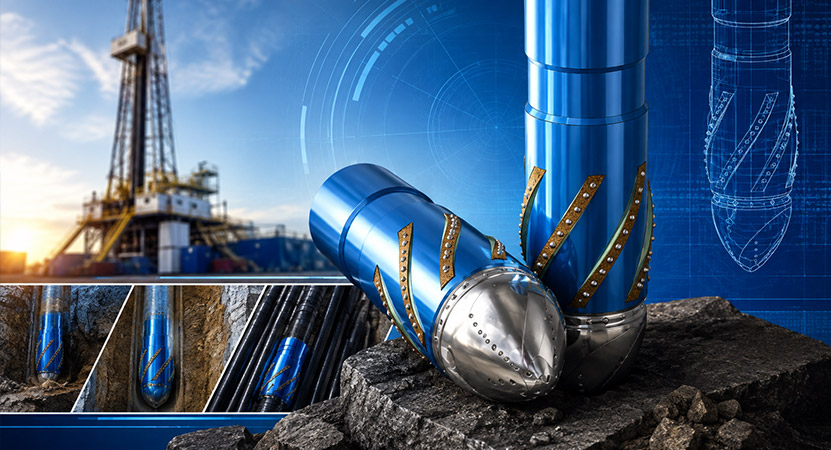
Emson describes its reamer shoe as having an advanced blade cutting structure and diamond-shaped faces designed to provide reaming capability.
Nose
The nose leads the casing through the wellbore.
Different nose configurations may be used depending on the application.
An eccentric nose, for example, can help guide casing around certain ledges or irregularities. Other designs use bullet or concentric noses.
The appropriate nose profile should be selected according to the well geometry and expected obstruction type.
Valve Assembly
Some reamer shoes incorporate a valve system.
The valve can help prevent cement backflow during cementing and can provide float-equipment functionality.
Emson currently offers single- and double-valve reamer shoe configurations.
Flow Ports
Flow ports allow drilling fluid or cement to move through the shoe.
Port geometry can affect:
Manufacturers commonly emphasize flow-directed or large-area ports as an important reamer-shoe design feature.
Casing Connection
The connection must match the casing or liner specification.
Depending on the manufacturer, available connections can include API or premium casing connections.
Reamer shoes can be categorized according to valve configuration, nose design and cutting structure.
Single-Valve Reamer Shoe
A single-valve reamer shoe contains one check-valve mechanism.
The valve provides controlled fluid movement and helps prevent reverse flow during cementing.
This configuration may be suitable for conventional applications where one valve meets the required operational and pressure specifications.
Double-Valve Reamer Shoe
A double-valve reamer shoe incorporates two valve elements.
The second valve can provide additional redundancy for backflow control.
As with float collars and float shoes, the presence of two valves should not automatically be interpreted as meaning that the product has twice the pressure rating. Actual performance depends on the complete design, materials, testing and operating conditions.
Emson offers both single- and double-valve reamer shoes.
Valveless Reamer Shoe
A valveless reamer shoe focuses on casing guidance and reaming rather than integrated backflow control.
In such an arrangement, another float component—such as a float collar—may be used to provide the required fluid-control function.
Ferro-Tube, for example, describes its U400 reamer shoe as primarily a reaming guide shoe without a valve and notes that it can be used with a float collar.
Eccentric-Nose Reamer Shoe
An eccentric nose shifts the leading geometry away from the centerline.
This can help the shoe negotiate certain ledges and irregular wellbore sections.
Several commercial reamer shoe designs incorporate aluminum eccentric noses with down jets.
Specialized Cutting-Structure Reamer Shoe
Different blade profiles and cutting materials can be selected for different well conditions.
The cutting structure may be optimized for:
The appropriate cutting profile should be selected according to the actual obstruction and casing-running procedure.
A reamer shoe and a float shoe are both installed near the bottom of the casing string, but they serve different primary purposes.
A float shoe is primarily designed to guide casing and provide one-way fluid control through its valve.
A reamer shoe adds a mechanical reaming function to help the casing negotiate problematic wellbore sections.
| Feature | Reamer Shoe | Float Shoe |
|---|---|---|
| Primary purpose | Guide + ream | Guide + fluid control |
| Cutting structure | Yes | Normally no |
| Tight-spot negotiation | Strong capability | Limited |
| Rotation/reciprocation | May be designed for it | Not its primary function |
| Check valve | Depending on design | Commonly incorporated |
| Cementing function | Depending on valve configuration | Yes |
| Typical application | Challenging wellbores | Conventional casing cementing |
| Best suited for | Ledges, bridges, tight spots, irregular holes | Standard casing running |
A reamer shoe is therefore not simply a stronger float shoe. It is designed to address a different operational requirement.
A guide shoe primarily helps the casing move through the wellbore.
It does not normally have a cutting structure.
A reamer shoe provides the same basic guiding role but adds a cutting/reaming structure for difficult wellbore conditions.
Baker Hughes describes a guide shoe as equipment placed at the bottom of casing to guide it to total depth, while describing a reamer shoe as an enhanced shoe designed to overcome wellbore obstructions.
| Feature | Reamer Shoe | Guide Shoe |
|---|---|---|
| Casing guidance | Yes | Yes |
| Cutting/reaming | Yes | No |
| Check valve | Design-dependent | Generally no |
| Tight-spot capability | High | Limited |
| Rotation/reciprocation | Application-dependent | Not primary function |
| Typical use | Difficult wellbore | Conventional casing running |
Reamer shoes are particularly valuable where the casing or liner must pass through a wellbore that is not perfectly gauge or contains known/anticipated restrictions.
Tight Wellbores
A tight spot can prevent casing from reaching the planned depth.
A reamer shoe can help the casing negotiate such restrictions while running.
Open-Hole Bridges
Bridges can form in the open-hole section and obstruct casing movement.
Reamer shoes are designed for applications involving open-hole bridges and similar obstructions.
Ledges and Ridges
Ledges can create a mechanical obstruction as the casing moves downward.
Specialized nose designs and cutting structures can help the shoe navigate these sections.
Swelling Shale
Reactive formations can swell after drilling and reduce the effective wellbore diameter.
A reamer shoe can help negotiate restricted sections during casing installation.
Sloughing Formations
Unstable formations may produce debris that accumulates in the wellbore.
The reamer shoe can help clear certain restrictions while circulation assists with debris transport.
Highly Deviated Wells
Casing movement becomes more difficult as deviation and dogleg severity increase.
Reamer shoes can provide an additional mechanism for negotiating difficult sections.
Commercial suppliers specifically identify high-angle, extended-reach and deviated wells as applications for reamer shoes.
Horizontal Wells
Horizontal sections can present challenges related to casing friction, cuttings beds and irregular wellbore geometry.
The appropriate reamer shoe configuration should be evaluated together with the casing-running procedure.
Liner Running
Reamer shoes are also used on liner strings.
Their function remains similar: help the liner negotiate restrictions and reach the planned setting depth.
Improved Casing Navigation: The cutting structure helps the casing negotiate difficult sections.
Reduced Risk of Stuck Casing: By addressing certain restrictions during casing running, a reamer shoe can reduce the risk associated with premature casing stoppage.
This does not eliminate stuck-casing risk, but it provides an additional tool for challenging wellbore conditions.
Reduced Need for Separate Remedial Reaming: In suitable applications, casing reaming can be performed while running the string rather than requiring a separate operation to condition the entire problematic section. Odfjell Technology notes that casing reaming can address tight spots, ledges, high doglegs and cutting beds and can reduce operational time in appropriate applications.
Improved Wellbore Accessibility: The cutting structure can help re-establish a more suitable passage through localized restrictions.
Support for Cementing: Where the reamer shoe incorporates appropriate flow ports and valve equipment, the tool can support circulation and cementing operations.
Drillability: Many modern reamer shoes are designed to be drilled out after cementing.
Emson specifies that its reamer shoes are suitable for PDC and rock-bit drill-out.
Selecting a reamer shoe requires a complete understanding of the casing and well conditions.
| Specification | What to Confirm |
|---|---|
| Product type | Reamer shoe / casing reamer shoe |
| Casing size | Exact casing OD |
| Hole size | Open-hole diameter |
| Cutting OD | Required reaming/gauge diameter |
| Valve configuration | Single, double or valveless |
| Nose type | Eccentric, bullet, concentric or application-specific |
| Cutting structure | Carbide/PDC/other engineered structure |
| Connection | API or premium connection |
| Casing grade | Compatible casing specification |
| Pressure | Required backpressure rating |
| Temperature | Expected downhole temperature |
| Flow rate | Required circulation rate |
| Well geometry | Vertical, deviated or horizontal |
| Rotation | Required casing rotation |
| Reciprocation | Required casing movement |
| Drill-out | PDC, roller cone or other method |
| Material | Body, nose and cutting-component materials |
| Customization | Blade OD, nose and connection requirements |
Emson’s current reamer shoe product information specifies 4½-inch to 30-inch sizes, single- and double-valve options, a high-strength alloy nose, aluminum components, PDC and rock-bit drillability, and compatibility with casing and liner hanger assemblies.
Exact dimensions, pressure ratings and operating parameters should always be confirmed from the latest manufacturer datasheet before procurement.
A reamer shoe should be selected based on the well problem it is expected to solve, not simply the casing diameter.
1. Confirm Casing Size
Start with the exact casing or liner OD.
The connection, body dimensions and shoe configuration must be compatible with the casing string.
2. Confirm Hole Size
The drilled hole size determines the available clearance and the appropriate cutting/blade OD.
3. Identify the Wellbore Problem
Determine what is expected to prevent the casing from reaching TD.
For example:
The obstruction type should influence the nose and cutting-structure selection.
4. Evaluate Well Geometry
Determine whether the well is:
More challenging geometry may require a more specialized reamer shoe configuration.
5. Select Valve Configuration
Determine whether the shoe needs:
If a separate float collar will provide backflow control, a valveless reamer shoe may be appropriate.
If the shoe itself is expected to provide float functionality, a valve-equipped design should be considered.
6. Select the Nose Profile
An eccentric nose may be appropriate for certain ledges and irregularities.
Other well conditions may favor a concentric or bullet configuration.
7. Evaluate Cutting Structure
The blade profile, OD and cutting material should match the expected formation and obstruction.
8. Confirm Flow Requirements
Review circulation rate and flow area.
Flow ports should provide adequate circulation without unnecessarily restricting the casing system.
9. Check Pressure and Temperature
For valve-equipped reamer shoes, verify pressure and temperature ratings against the cementing program.
10. Confirm Drill-Out Requirements
Determine how the shoe will be drilled out after cementing.
Confirm compatibility with the planned PDC or roller-cone drill-out procedure.
11. Confirm Connection
The casing connection must match the required casing specification.
12. Discuss Special Requirements With the Manufacturer
For difficult wells, provide the manufacturer with as much information as possible, including:
Two of the most important design areas are the cutting structure and nose profile.
Cutting Structure
The cutting structure determines how effectively the shoe can interact with wellbore restrictions.
Different manufacturers use different blade geometries and cutting materials.
Common considerations include:
Weatherford’s reamer shoe range, for example, emphasizes cutting structures designed for difficult formations and 360-degree coverage.
Nose Design
The nose leads the casing into the wellbore.
An eccentric nose can be particularly useful for guiding the casing around certain ledges and irregular sections.
Some commercial designs use aluminum eccentric noses with integral down jets, while larger sizes may use alternative nose profiles.
The correct configuration should be based on the actual well geometry rather than simply selecting the most aggressive cutting structure.
Although the primary reason for selecting a reamer shoe is usually casing-running performance, the shoe must also be considered as part of the cementing system.
A reamer shoe may include:
When equipped with a valve, the reamer shoe can help prevent cement from flowing back into the casing after displacement.
However, not every reamer shoe is a float shoe.
Valveless reamer shoes can be paired with a float collar or other float equipment to provide the required backflow-control function.
This is why procurement teams should evaluate the complete shoe-track arrangement rather than specifying a reamer shoe independently.
A typical casing arrangement can vary according to the cementing program.
One possible arrangement is:
Casing String → Float Collar → Casing Joint → Reamer Shoe
Another configuration may use a valve-equipped reamer shoe at the bottom of the casing string.
The correct arrangement depends on:
The reamer shoe should therefore be selected as part of the overall casing and cementing system.
Choosing Only by Casing Diameter
Casing size is only the starting point.
The hole size, obstruction type, blade OD, nose design, valve configuration and operating procedure also matter.
Using a Standard Shoe in a Known Problematic Wellbore
If the drilling history already indicates ledges, tight spots or unstable formations, a conventional guide shoe may not provide sufficient casing-running capability.
Selecting an Aggressive Cutting Structure Without Considering Flow
More aggressive cutting does not necessarily mean better performance.
Flow area and hole-cleaning requirements must also be considered.
Ignoring Rotation and Reciprocation Requirements
Some reamer shoe applications depend on casing movement to activate the cutting structure effectively.
The tool must therefore be compatible with the planned casing-running procedure.
Ignoring Drill-Out
A shoe that performs well during casing running must still be drillable after cementing if the well program requires it.
Not Considering Valve Requirements
A valveless reamer shoe and a valve-equipped reamer shoe serve different purposes.
The complete float-equipment arrangement should be evaluated.
Not Sharing Well Conditions With the Manufacturer
A supplier cannot optimize a reamer shoe selection without understanding the actual well problem.
Providing the drilling report, hole size, casing size and expected obstruction can significantly improve product selection.
For oilfield procurement teams, selecting a reamer shoe manufacturer involves more than comparing catalogue prices.
A suitable manufacturer should be able to provide:
Emson Oil Tools currently manufactures single- and double-valve reamer shoes for casing and liner-running applications. Its published product information identifies sizes from 4½ inches to 30 inches, PDC and rock-bit drillability, high-strength alloy nose construction and compatibility with casing and liner hanger assemblies.
The company positions its reamer shoes for vertical, horizontal and deviated wells and identifies applications involving ledges, swelling shale, mud-cake buildup, porous formations and sand bridges.
For project-specific requirements, buyers should provide the casing and wellbore specifications so the appropriate reamer shoe configuration can be evaluated.
A reamer shoe is an application-specific downhole component. Its value depends on how well the cutting structure, nose, valve and flow characteristics match the well conditions.
Emson’s current reamer shoe range provides:
These characteristics make the product suitable for evaluating conventional casing-running applications as well as more challenging vertical, deviated and horizontal wells.
For international procurement, the buyer should provide complete application information rather than ordering solely by nominal casing size.
1. What is a reamer shoe in oilfield operations?
A reamer shoe is a specialized casing or liner shoe installed at the bottom of the string to help guide it through difficult wellbore conditions. Its cutting structure can help negotiate tight spots, ledges, bridges and other restrictions.
2. What is the main purpose of a reamer shoe?
Its main purpose is to help casing or liner strings reach planned total depth when the wellbore contains restrictions or irregularities that could prevent conventional casing running.
3. What is the difference between a reamer shoe and a float shoe?
A float shoe primarily provides casing guidance and one-way fluid control. A reamer shoe adds a cutting or reaming structure that helps the casing negotiate difficult wellbore sections.
4. Can a reamer shoe be used in horizontal wells?
Yes. Reamer shoes can be used in horizontal and highly deviated wells when the selected configuration is appropriate for the well conditions and casing-running procedure.
5. Do all reamer shoes have valves?
No. Some reamer shoes are valveless, while others include single- or double-valve configurations. The choice depends on whether the shoe itself needs to provide float functionality or whether another component, such as a float collar, provides backflow control.
6. What is a single-valve reamer shoe?
A single-valve reamer shoe contains one check-valve mechanism and provides reaming capability together with fluid-control functionality.
7. What is a double-valve reamer shoe?
A double-valve reamer shoe incorporates two valve elements to provide additional redundancy in fluid-control applications. The actual pressure rating and performance must be confirmed from the manufacturer’s specifications.
8. Are reamer shoes drillable?
Many reamer shoes are designed to be drilled out after cementing. Emson specifies its reamer shoes as suitable for PDC and rock-bit drill-out.
9. What materials are used in reamer shoe cutting structures?
Commercial designs commonly use carbide-based cutting structures, including tungsten carbide, while specialized designs may incorporate other engineered cutting materials or PDC elements. The appropriate material depends on the application and manufacturer design.
10. What well conditions require a reamer shoe?
Common applications include tight spots, ledges, bridges, swelling shale, sloughing formations, washouts, sand bridges and highly deviated or irregular well sections.
11. What information is required to select a reamer shoe?
Important information includes casing size, hole size, casing grade, connection, well trajectory, expected obstruction, cutting requirements, valve configuration, pressure, temperature, circulation requirements and drill-out method.
12. Can a reamer shoe be customized?
Depending on the manufacturer, customization can include cutting/blade OD, nose configuration, valve arrangement, connection and other application-specific characteristics. Emson states that special sizes and custom configurations are available upon request.
Reamer shoes are part of a broader casing-running and cementing equipment system.
Relevant related products include:
Recommended internal-link structure:
Reamer Shoe → Float Shoe → Float Collar → Guide Shoe → Cementing Plugs → Centralizers → Stop Collars
This creates a strong topical relationship between casing-running, centralization and cementing equipment.
Selecting the correct reamer shoe can help reduce casing-running challenges in difficult wellbore conditions.
Whether you require a single-valve reamer shoe, double-valve reamer shoe or a specialized casing/liner reaming solution, the product should be selected according to the actual well conditions and casing program.
Looking for a Reamer Shoe for Your Casing or Liner Application?
For an accurate quotation, provide:
Casing Size | Hole Size | Casing Grade | Connection | Well Type | Expected Obstruction | Valve Requirement | Pressure/Temperature | Quantity | Delivery Location
Providing this information allows the manufacturer to evaluate the appropriate reamer shoe configuration rather than simply supplying a generic casing shoe.
Copyright © 2020 - Emson Oil Tools. All Right Reserved. | Privacy Policy | Terms & Conditions