
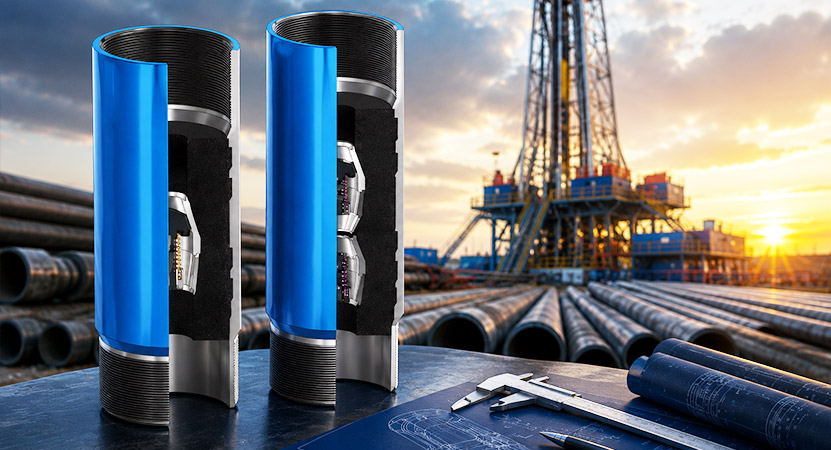
A float collar is a critical component of casing and cementing equipment used during oil and gas well construction. Installed near the lower end of the casing string, typically above the float shoe, a float collar performs two important functions: it provides controlled one-way fluid flow during casing and cementing operations and provides a landing point for cementing plugs during primary cementing.
The internal check-valve mechanism helps prevent cement slurry from flowing back into the casing after displacement. This is particularly important because cement placed in the annulus can create a hydrostatic pressure difference that may cause the slurry to flow back toward the casing if adequate backflow control is not maintained.
A float collar is therefore not simply a connection between casing joints. It forms part of the casing shoe-track system, working together with components such as the float shoe, cementing plugs and casing itself to support controlled cement placement and well integrity.
Different float collar configurations are available for different well conditions and cementing methods. Conventional single-valve and double-valve float collars are widely used, while specialized designs include non-rotating, stab-in and auto-fill configurations. Emson Oil Tools’ current float collar range includes these types and is designed for vertical, horizontal and deviated well applications.
This guide explains what a float collar is, how it works, its construction and valve configurations, applications, differences from a float shoe, selection considerations, and the information oilfield buyers should evaluate when sourcing a float collar.
A float collar is a short casing component equipped with an internal check-valve system. It is installed near the bottom of the casing string, commonly one to three casing joints above the float shoe. Its position and exact spacing depend on the casing and cementing program.
The float collar’s check valve permits fluid to flow through the casing in the required direction during cement displacement while helping prevent fluid or cement from flowing back into the casing.
The component also provides a landing point for cementing plugs. During primary cementing, plugs are pumped through the casing as part of the displacement process. The float collar provides a controlled landing surface for the plug and helps establish the pressure response associated with the end of displacement.
A typical casing shoe-track arrangement may therefore include:
Casing → Float Collar → Casing Joint(s) → Float Shoe
The float collar and float shoe have related but different functions. The float shoe is normally positioned at the bottom of the casing string, while the float collar is positioned above it.
Why is It Called a “Float” Collar?
The term “float” relates to the ability of the equipment to support controlled fluid movement and casing buoyancy during casing-running operations, in addition to its important role in cementing. During casing deployment, the internal valve system can influence how fluid enters or exits the casing, depending on the particular float equipment design and operating procedure.
In modern oilfield operations, however, the float collar is particularly important for cementing, backflow control and cement-plug landing.
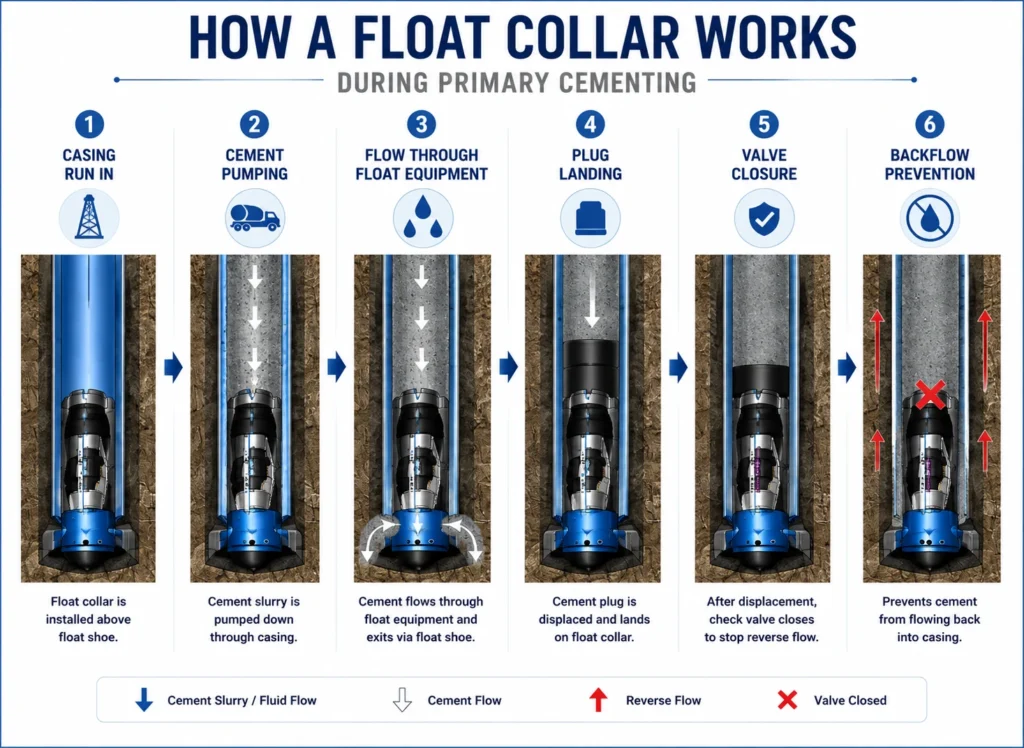
The operation of a float collar can be understood by looking at the casing-running and primary-cementing sequence.
1. Float Collar Installation
The float collar is installed in the lower portion of the casing string, normally above the float shoe.
The distance between the float collar and float shoe is determined by the casing and cementing design.
This spacing can also influence the amount of cement that remains inside the casing below the collar after displacement. The section below the collar can contain cement that may have become contaminated during displacement, allowing cleaner cement to remain above the shoe-track area.
2. Casing is Run Into the Well
The casing string is lowered into the wellbore with the float collar forming part of the lower casing assembly.
Depending on the float collar configuration, the valve can control fluid movement during casing running and may contribute to casing buoyancy management.
Specialized auto-fill and differential-fill designs are specifically intended to manage casing filling during running.
3. Cementing Begins
After the casing reaches the planned depth and the cementing operation starts, cement slurry is pumped down through the casing.
The cement travels through the casing toward the shoe-track assembly.
4. Cement Passes Through the Float Equipment
The cement continues through the lower casing assembly and exits through the float shoe into the annulus.
The float collar’s valve permits the intended flow during displacement.
5. Cementing Plug Lands on the Float Collar
A cementing plug is displaced through the casing and eventually reaches the float collar.
The float collar provides the landing seat for the plug.
This provides a defined endpoint for displacement and helps separate the cementing fluids according to the cementing procedure.
6. The Valve Prevents Backflow
When pumping pressure is released or the pressure conditions change after displacement, the check valve closes to help prevent cement from flowing backward into the casing.
This is essential for maintaining the intended cement placement in the annulus.
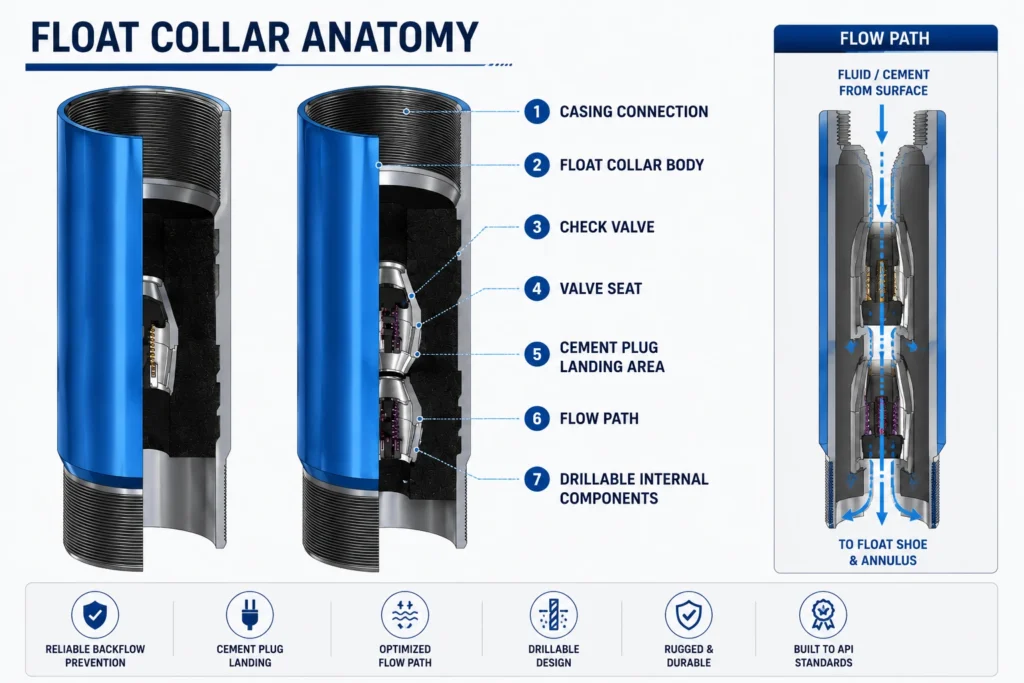
The exact construction of a float collar varies by manufacturer and configuration. However, typical float collars contain several key components.
Float Collar Body
The body provides the structural housing for the valve assembly and connects the equipment to the casing string.
It must be manufactured to the required casing dimensions and connection specification.
Emson states that its float collars are manufactured from seamless casing-grade steel, with designs intended for oilfield casing applications.
Check-Valve Assembly
The check valve is the principal functional component.
Depending on the design, float equipment may use plunger, ball or flapper-type valve mechanisms. Different valve designs have different flow characteristics, operating behavior and drill-out considerations.
Valve Seat and Sealing Elements
The valve must establish a reliable seal against reverse flow.
The seat and sealing components therefore need to be compatible with the expected pressure, temperature, fluids and cementing environment.
Cement-Plug Landing Seat
The internal configuration provides a landing surface for the cementing plug.
This is one of the primary distinctions between a float collar and equipment designed solely for casing guidance.
Casing Connections
The upper and lower connections must match the casing string and project requirements.
Thread compatibility is essential during procurement.
Drillable Internal Components
Many modern float-collar designs use internal components that can be drilled out after cementing.
Emson states that its float collars are designed for drillability, while other manufacturers similarly emphasize PDC-drillable valve components.
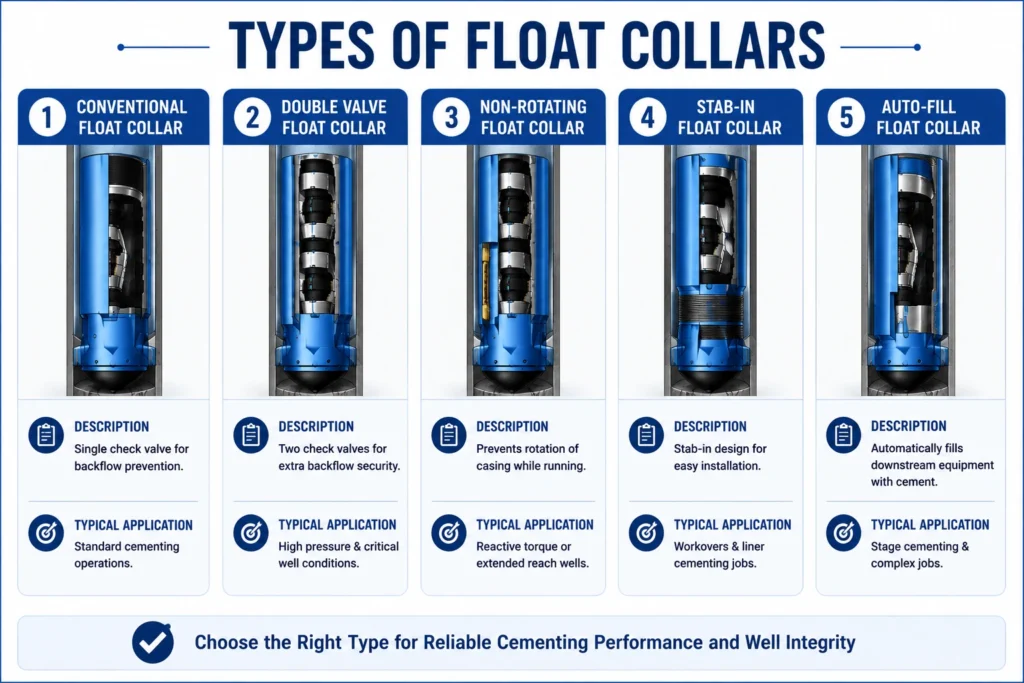
Float collars are available in different configurations to meet varying casing, cementing and well conditions.
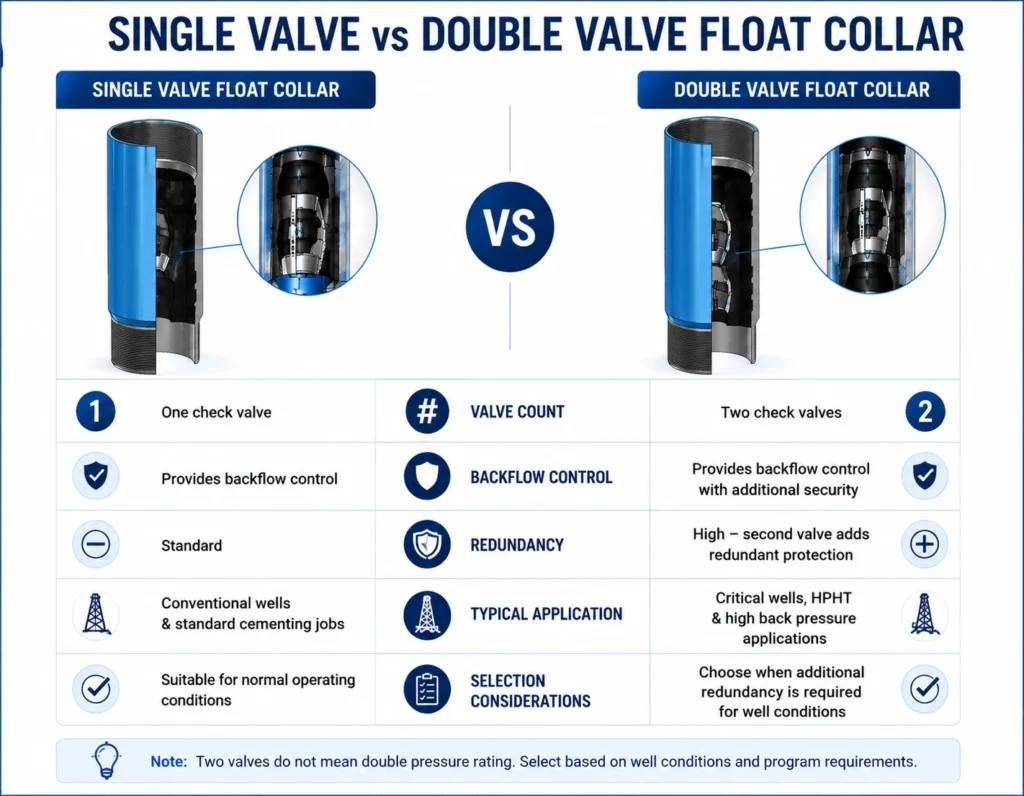
Single-Valve Float Collar
A single-valve float collar contains one primary check valve.
It is a common configuration for conventional cementing operations where one valve provides the required backflow-control function.
Single-valve equipment can be suitable for many standard casing programs, provided that its verified specifications meet the pressure, temperature, flow and cementing requirements of the application.
Double-Valve Float Collar
A double-valve float collar contains two valve elements.
The second valve provides additional redundancy if one valve does not establish the required seal.
However, an important technical point should be understood:
Two valves do not automatically mean twice the pressure rating.
Technical literature explains that the second valve primarily provides redundancy rather than doubling the equipment’s pressure rating or durability.
Double-valve configurations may therefore be considered for applications where additional backflow-control redundancy is desirable.
Non-Rotating Float Collar
A non-rotating float collar incorporates an anti-rotation mechanism designed to limit rotation during drill-out.
This can be particularly useful in applications where drill-out performance and positional stability are important.
Emson currently offers non-rotating float collars in single- and double-valve configurations.
Stab-In Float Collar
A stab-in float collar is used with inner-string cementing arrangements.
In inner-string cementing, drill pipe or tubing is run inside the casing and connected to the float equipment through a suitable mechanism. Cement is then pumped through the inner string and into the casing/annulus system.
This method is commonly used with large-diameter casing and can reduce displacement volume, cement volume and certain equipment requirements.
Auto-Fill Float Collar
An auto-fill float collar allows the casing to fill automatically or in a controlled manner during casing running, depending on the specific design.
This can help manage casing-running time, buoyancy and surge-related considerations.
Some auto-fill designs can subsequently be converted to conventional backpressure operation before cementing begins. The exact conversion method and operating pressures are design-specific and must follow the manufacturer’s instructions.
| Feature | Single-Valve Float Collar | Double-Valve Float Collar |
|---|---|---|
| Number of primary valve elements | One | Two |
| Main function | Backflow control | Backflow control with additional redundancy |
| Typical application | Conventional casing/cementing | Applications requiring additional valve redundancy |
| Backpressure control | Design-specific | Design-specific |
| Pressure rating | Manufacturer-specific | Manufacturer-specific |
| Drill-out | Depends on design | Depends on design |
| Selection basis | Well and cementing program | Well and cementing program |
| Key advantage | Simpler configuration | Additional valve redundancy |
The choice should be based on the complete well program. A double-valve collar should not be selected simply because it has two valves; the actual operating conditions and failure risks should determine whether the additional redundancy is warranted.
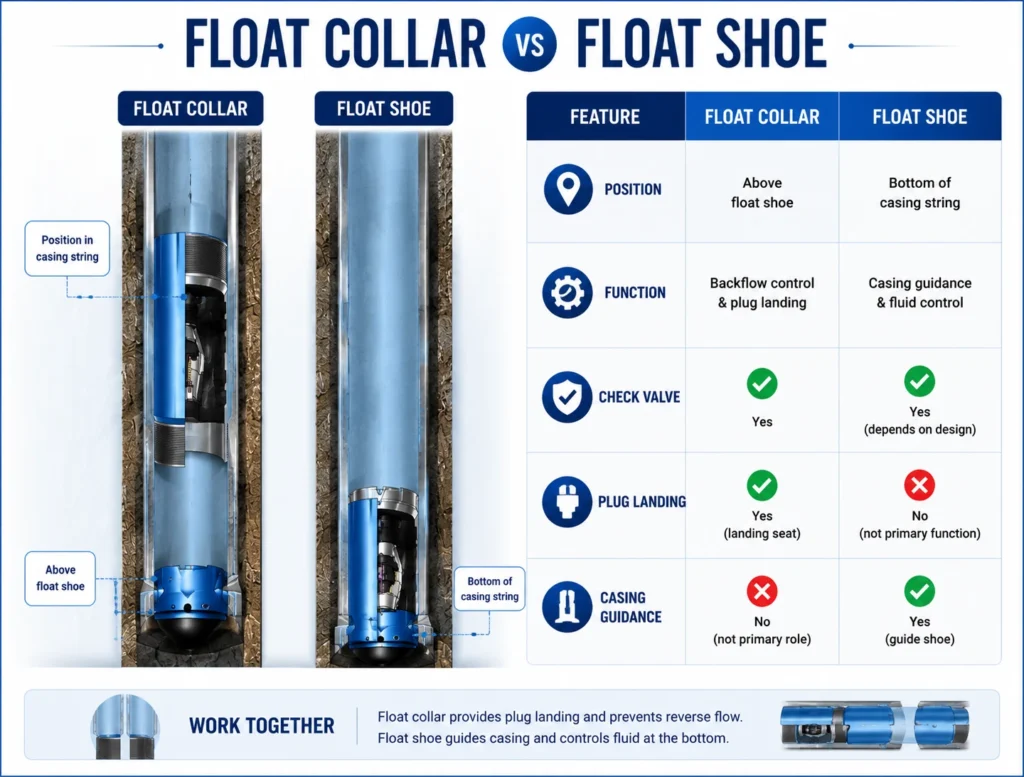
Float collars and float shoes are frequently used together, but they have different positions and functions within the casing assembly.
The float shoe is generally installed at the bottom of the casing string, while the float collar is installed above the float shoe.
The float shoe provides casing guidance and fluid-control functionality, while the float collar provides fluid control and a landing point for cementing plugs.
| Feature | Float Collar | Float Shoe |
|---|---|---|
| Typical location | Above float shoe | Bottom of casing |
| Primary function | Backflow control and plug landing | Casing guidance and fluid control |
| Check valve | Yes, depending on configuration | Yes, depending on configuration |
| Cement plug landing | Yes | Not normally its primary function |
| Casing guidance | Not its primary function | Important function |
| Shoe-track position | Above shoe | Bottom |
| Typical role | Cementing and casing operations | Casing running and cementing |
The two components are therefore complementary.
In a conventional shoe-track arrangement, the float collar can provide a landing point for the cementing plug while the float shoe forms the lower end of the casing assembly.
A guide shoe is primarily designed to help guide casing through the wellbore.
A float collar, in contrast, is installed higher in the casing string and provides fluid-control and cement-plug landing functions.
When a guide shoe is used without a float valve at the shoe, greater reliance is placed on the float collar’s valve for backflow control. Technical literature notes that double-valve float collars may be considered in such arrangements where additional redundancy is required.
| Feature | Float Collar | Guide Shoe |
|---|---|---|
| Typical position | Above casing shoe | Bottom of casing |
| Check valve | Yes | Typically no |
| Cement plug landing | Yes | No |
| Primary role | Fluid control and plug landing | Casing guidance |
| Common use | Primary cementing | Casing running |
Float collars are used across a broad range of casing and cementing operations.
Primary Cementing
Primary cementing is the most important application.
The float collar provides a check valve to help prevent cement backflow and a landing seat for the cementing plug.
This supports controlled cement placement in the annulus and contributes to the overall cementing system.
Deep Wells
Deep wells can create substantial hydrostatic pressure and operational challenges.
The float collar must therefore be selected according to the actual pressure, temperature and cementing requirements.
Deviated Wells
As well deviation increases, casing running and cement placement can become more complex.
Specialized float collar configurations, including non-rotating designs, may be considered where the application requires additional operational control.
Horizontal Wells
Horizontal wells introduce additional casing-running and cement-placement considerations.
Float equipment should be evaluated together with the casing design, well trajectory, cementing program and other casing accessories.
Emson positions its float collars for vertical, horizontal and deviated well applications.
HPHT Wells
High-pressure, high-temperature wells place additional demands on casing and cementing equipment.
The float collar must be selected based on verified pressure and temperature requirements and the appropriate testing category.
Large-Diameter Casing
Stab-in float collars can be used in inner-string cementing applications involving large-diameter casing.
Inner-string cementing can reduce displacement volume and cement volume and may simplify certain aspects of large-casing cementing.
Liner Cementing
Specialized float collar configurations can be used in liner applications where casing or liner deployment and cementing require controlled fluid movement and backflow prevention.
A properly selected float collar supports several important aspects of casing and cementing operations.
Backflow Prevention: The check valve helps prevent cement slurry from flowing back into the casing after displacement.
Cement Plug Landing: The float collar provides a controlled landing point for the cementing plug.
Improved Cement Placement: By helping control reverse flow and supporting the cementing sequence, the float collar contributes to the intended placement of cement.
Casing Buoyancy Management: Depending on the design, float equipment can assist with controlled casing filling and buoyancy management during casing running.
Valve Redundancy: Double-valve designs can provide an additional valve barrier when the application requires increased redundancy.
Drill-Out Capability: Modern float collar designs can incorporate drillable internal components to facilitate post-cementing drill-out.
Compatibility With Specialized Operations: Stab-in, auto-fill and non-rotating designs allow float collars to be adapted to specific casing and cementing requirements.
Selecting a float collar requires more information than simply specifying the product name.
A procurement specification should normally consider the following:
| Specification | What to Confirm |
|---|---|
| Float collar type | Conventional, non-rotating, stab-in, auto-fill, etc. |
| Valve configuration | Single or double valve |
| Casing size | Exact casing OD |
| Casing grade | Compatible casing grade |
| Connection | Required thread/connection |
| Pressure | Expected operating and test requirements |
| Temperature | Expected downhole temperature |
| Well geometry | Vertical, deviated or horizontal |
| Cementing method | Conventional, inner-string or specialized |
| Plug type | Compatible cementing plug |
| Drill-out | Drillable internal components |
| Material | Body and internal component materials |
| Testing | Applicable API/project testing requirements |
| Customization | Special dimensional or operational requirements |
| Quantity | Required project quantity |
| Documentation | Drawings, datasheets and quality documents |
Emson’s current product information states that its float collars are manufactured from seamless casing-grade steel and tested to meet API SPEC 10F requirements. The product range includes non-rotating, conventional, stab-in and auto-fill configurations.
The exact technical specification should always be confirmed against the latest manufacturer datasheet and project requirements before procurement.
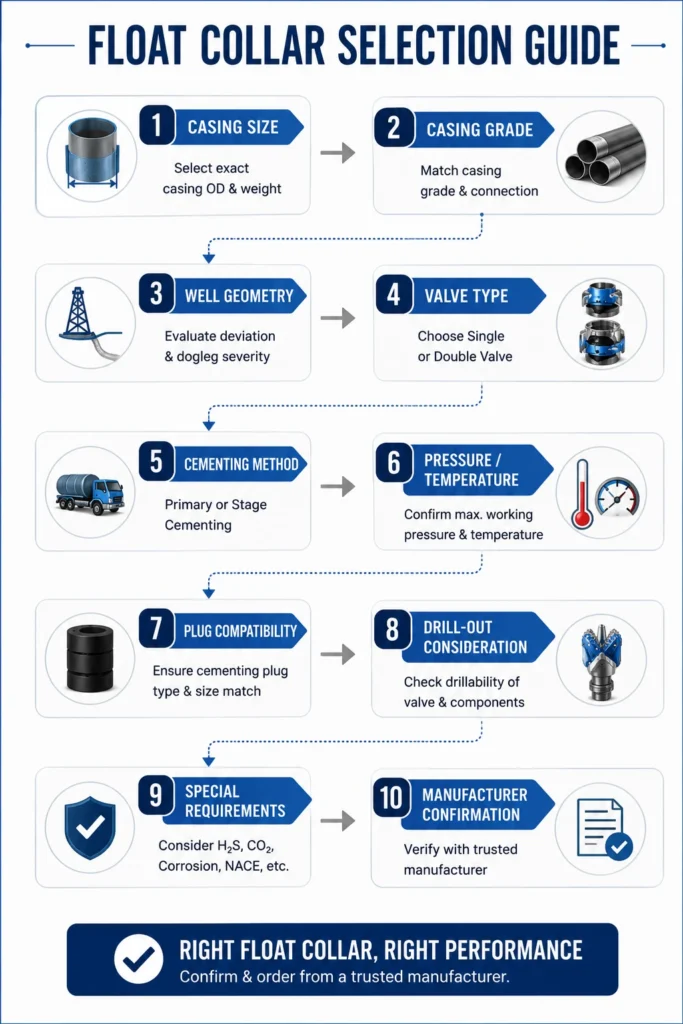
The correct float collar should be selected as part of the complete casing and cementing program.
1. Confirm Casing Size: The float collar must match the casing size and required connection.
Do not select the collar solely from a general nominal-size description. Confirm the exact casing specification.
2. Confirm Casing Grade: The float collar body and connection should be compatible with the casing grade and operating environment.
3. Evaluate Well Geometry: Determine whether the application involves:
Well trajectory can influence casing-running, torque and drill-out requirements.
4. Select Valve Configuration: Determine whether a single-valve or double-valve design is appropriate.
For applications where redundancy is important, a double-valve configuration may be considered.
5. Determine the Cementing Method: Identify whether the operation uses:
This is particularly important when considering stab-in float collars.
6. Consider Casing-Fill Requirements: If controlled casing filling is required during running, an auto-fill or differential-fill configuration may be appropriate depending on the operating procedure.
7. Evaluate Pressure and Temperature: Confirm the expected downhole pressure and temperature.
The selected equipment and testing category should correspond to the actual operating environment. Technical literature notes that API testing categories should be selected according to expected flow, temperature and pressure conditions.
8. Consider Drill-Out Requirements: Determine how the float collar will be drilled out after cementing.
If PDC drilling is planned, confirm that the internal components are compatible with the planned drill-out procedure.
9. Confirm Plug Compatibility: The cementing plug must be compatible with the float collar’s landing configuration.
10. Discuss Special Requirements With the Manufacturer: For HPHT, highly deviated, horizontal, large-diameter or other specialized applications, provide complete well and casing information to the manufacturer before ordering.
Choosing between conventional and specialized float collars depends on the operational objective.
| Float Collar Type | Primary Consideration | Typical Application |
|---|---|---|
| Conventional | Standard backflow control and plug landing | Conventional cementing |
| Double-Valve | Additional valve redundancy | Applications requiring additional backflow redundancy |
| Non-Rotating | Reduced rotation during drill-out | Applications where drill-out stability matters |
| Stab-In | Inner-string cementing | Large-diameter casing and specialized cementing |
| Auto-Fill | Controlled casing filling | Casing-running operations requiring automatic filling |
The table is intended as a selection framework rather than a substitute for manufacturer specifications. Exact capabilities differ between designs and suppliers.
Correct installation is as important as selecting the correct float collar.
Before installation, confirm:
The casing assembly should be handled carefully to avoid damage to threads, sealing surfaces and valve components.
During cementing, operating procedures should follow the approved cementing program.
For specialized configurations such as auto-fill or stab-in float collars, the operating sequence may differ substantially from a conventional float collar. The manufacturer’s operating procedure should therefore be followed precisely.
Selecting Only by Casing Size
Casing size is necessary but not sufficient.
Valve configuration, connection, pressure, temperature and cementing method must also be considered.
Choosing a Double Valve Without Understanding Why
A double valve provides redundancy, but it does not automatically double the pressure rating.
The selection should be based on the actual operational risk and cementing program.
Ignoring Plug Compatibility
The cementing plug must land correctly on the float collar.
An incompatible plug/collar combination can compromise the intended displacement procedure.
Ignoring Drill-Out Requirements
Internal components should be evaluated for compatibility with the planned drill-out method.
Using Conventional Equipment for Specialized Cementing
Large-diameter casing or inner-string cementing may require specialized stab-in equipment rather than a conventional float collar.
Not Considering Well Geometry
A float collar suitable for a conventional vertical well may not automatically be the best configuration for a highly deviated or horizontal well.
Not Providing Complete RFQ Information
A supplier cannot properly evaluate a specialized float collar if the RFQ contains only the phrase:
“Need 9 5/8 inch float collar.”
The buyer should provide casing size, grade, connection, well conditions, cementing method, valve requirement and quantity wherever possible.
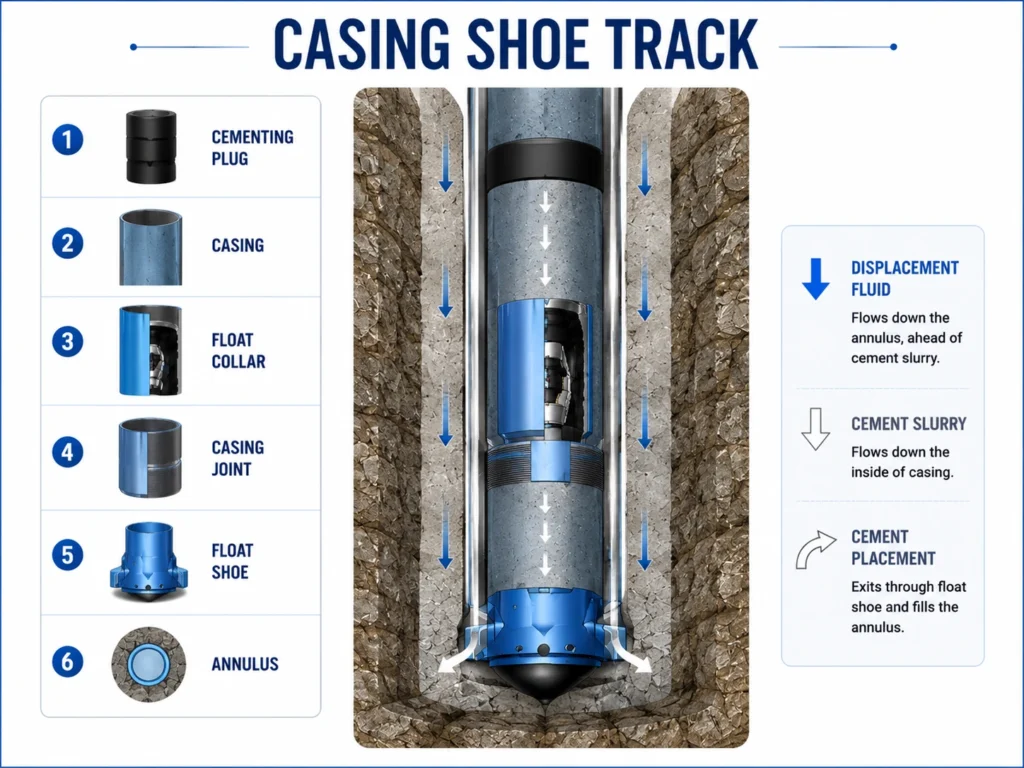
The float collar is best understood as part of the complete casing shoe track.
A conventional arrangement may look like:
Casing String
↓
Cementing Plug
↓
Casing Joints
↓
Float Collar
↓
Casing Joint(s)
↓
Float Shoe
↓
Wellbore / Annulus
The float shoe is positioned at the bottom and provides the casing-guidance function. The float collar is positioned above it and provides a check valve and cement-plug landing point.
The spacing between the float collar and float shoe also has an operational purpose. It can provide space for cement that may be contaminated during the displacement process, helping cleaner cement remain above the shoe-track area.
The float collar is a downhole pressure-control and cementing component. Its reliability therefore matters beyond simple dimensional compatibility.
Important quality considerations include:
Dimensional Accuracy: The body and casing connections should meet the specified dimensions.
Valve Reliability: The valve must perform its intended flow-control function under the specified operating conditions.
Sealing Performance: The valve should provide the required resistance to reverse flow.
Material Quality: The body and internal components should be appropriate for the expected downhole environment.
Drill-Out Performance: Internal components should be suitable for the planned post-cementing drill-out.
Quality Documentation: For international B2B procurement, buyers may require:
Oilfield buyers sourcing float collars generally need more than a catalogue product.
A suitable manufacturer or supplier should be able to understand the casing and cementing application and recommend the appropriate configuration.
Important supplier capabilities include:
Emson Oil Tools currently offers float collars designed for vertical, horizontal and deviated wells. Its product range includes conventional, non-rotating, stab-in and auto-fill configurations, with single- and double-valve options available for relevant designs.
The company’s product information also states that its float collars use seamless casing-grade steel and are tested to meet API SPEC 10F requirements.
For project-specific requirements, buyers should provide complete casing and cementing details so the appropriate float collar can be evaluated.
For international oilfield procurement, the ability to supply different float-equipment configurations can be an important advantage.
Emson Oil Tools’ current float-collar portfolio includes:
The portfolio is intended to address different casing and cementing requirements rather than relying on a single universal float collar design.
Emson’s product information also identifies applications across vertical, horizontal and deviated wells and highlights casing-grade steel construction, API SPEC 10F testing and drillability.
For a specific project, buyers should provide the casing size, grade, connection, well conditions, cementing method and required valve configuration to receive an appropriate product recommendation.
1. What is a float collar in oilfield cementing?
A float collar is a casing component installed near the bottom of the casing string, usually above the float shoe. It incorporates a check valve to help prevent cement backflow and provides a landing seat for cementing plugs during primary cementing.
2. What is the main purpose of a float collar?
The two primary functions are to control reverse fluid flow through its check valve and provide a landing point for cementing plugs. These functions support controlled cement displacement and help maintain cement placement in the annulus.
3. Where is a float collar installed?
A float collar is normally installed one to three casing joints above the float shoe, although the exact position depends on the casing and cementing program.
4. What is the difference between a float collar and a float shoe?
A float shoe is installed at the bottom of the casing string and helps guide casing while controlling fluid flow. A float collar is positioned above the shoe and provides fluid control plus a landing seat for cementing plugs.
5. What is a single-valve float collar?
A single-valve float collar contains one check valve and is commonly used for conventional casing and cementing applications where the specified operating requirements can be met by a single valve.
6. What is a double-valve float collar?
A double-valve float collar contains two valve elements. The second valve provides additional redundancy. It should not be assumed that a double-valve collar automatically has twice the pressure rating of a single-valve design.
7. Are float collars used in horizontal wells?
Yes. Float collars can be used in horizontal and deviated wells when the selected configuration is suitable for the well conditions. Non-rotating or other specialized configurations may be considered for specific applications.
8. Are float collars drillable?
Many modern float collars use drillable internal components. The exact drill-out behavior depends on the product design, materials, drilling equipment and operating procedure. Emson states that its float collar designs provide drillability.
9. What is a non-rotating float collar?
A non-rotating float collar incorporates an anti-rotation mechanism intended to reduce rotation during drill-out. This can help support more controlled drill-out performance in applications where rotation is a concern.
10. What is a stab-in float collar?
A stab-in float collar is designed for inner-string cementing applications. A drillpipe or tubing string can connect to the float equipment through a suitable stab-in mechanism, allowing cement to be displaced through the inner string.
11. What is an auto-fill float collar?
An auto-fill float collar is designed to allow controlled casing filling during casing running. Depending on the design, the valve can allow fluid entry while the casing is being run and can subsequently be converted to conventional backpressure operation.
12. How do I select the right float collar?
Selection should consider casing size, casing grade, connection, well geometry, pressure, temperature, cementing method, valve configuration, cementing plug compatibility, drill-out requirements and any special project conditions.
A float collar normally works as part of a broader casing and cementing equipment system.
Relevant Emson product categories include:
Internal links from this article should connect the Float Collar page with these related products.
This creates a clear topical relationship:
Float Collar → Float Shoe → Guide Shoe → Reamer Shoe → Cementing Plugs → Centralization → Stop Collar
That structure can help users move naturally from technical research to related product evaluation.
Choosing the correct float collar is an important part of planning a reliable casing and cementing operation.
Whether you require a conventional single-valve float collar, double-valve configuration, non-rotating design, stab-in float collar or auto-fill solution, the equipment should be selected according to the actual casing and cementing program.
Looking for a Float Collar for Your Oilfield Application?
When sending an RFQ to Emson Oil Tools, provide:
Casing Size | Casing Grade | Connection | Valve Type | Well Type | Cementing Method | Pressure/Temperature | Quantity | Delivery Location
Providing complete technical information helps the manufacturer evaluate the appropriate float collar configuration for your application.
Copyright © 2020 - Emson Oil Tools. All Right Reserved. | Privacy Policy | Terms & Conditions