
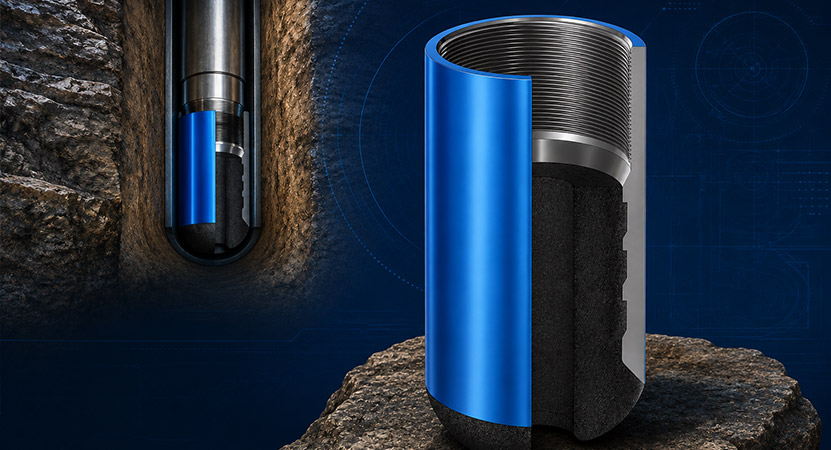
Running casing to the planned depth is one of the most important operations in well construction. The casing string must travel through the wellbore without becoming stuck, damaged or obstructed by ledges, irregular formations, doglegs, washouts or other wellbore conditions.
At the bottom of the casing string, a guide shoe provides a streamlined leading profile that helps the casing move through the wellbore.
Unlike a reamer shoe, which incorporates a cutting structure for negotiating more difficult restrictions, a conventional guide shoe is fundamentally a casing-guidance component. It provides a rounded or tapered nose that helps the casing pass over or around wellbore irregularities rather than allowing the square end of the casing to catch on them. Industry references describe the guide shoe as equipment installed at the bottom of casing specifically to guide it to total depth.
A guide shoe can also form part of a cementing system. Its internal passage allows drilling fluid and cement to flow through the bottom of the casing. Unlike a float shoe, a conventional guide shoe does not contain an integral one-way check valve. Consequently, when backflow prevention is required, a float collar or another float component is normally incorporated into the casing shoe-track design.
For drilling contractors, casing-running teams and procurement professionals, selecting a guide shoe involves more than choosing a casing size. Nose configuration, connection type, hole geometry, drillability, casing specification and the overall float-equipment arrangement should all be considered.
Emson Oil Tools currently offers guide shoes in sizes from 2⅞ inches to 30 inches, with butt-welded, slip-on and threaded connection options, fully PDC-drillable internal components and bullet, eccentric and spade nose configurations. The company states that its guide shoes are intended for vertical, deviated and horizontal casing operations.
This guide explains what a guide shoe is, how it works, its construction, types, applications, differences from float and reamer shoes, selection criteria and what buyers should consider when sourcing a guide shoe manufacturer or supplier.
A guide shoe is a casing accessory connected to the bottom of a casing string to provide a streamlined leading end and help the casing move through the wellbore.
The bottom of a conventional casing joint is relatively blunt. When lowered through an open hole, that blunt end can encounter:
A guide shoe changes the geometry of the casing’s leading end. Its rounded, tapered or specialized nose allows the casing to deflect and move past these irregularities more smoothly.
Industry references describe guide shoes as rounded components installed at the bottom of casing specifically to guide the casing toward total depth.
A conventional guide shoe generally contains a central flow passage. Drilling fluid can move through this passage while the casing is being run, and cement can subsequently be pumped through the casing and out into the annulus during cementing.
The defining characteristic is important:
A conventional guide shoe provides casing guidance but does not normally provide integral one-way backflow control.
Baker Hughes distinguishes guide shoes from float shoes and float collars specifically on this basis: guide shoes guide casing to total depth but do not contain one-way check valves.
This means the guide shoe should be considered as one component within a larger casing and cementing system.
The operating principle of a guide shoe is simple: it creates a smoother leading profile for the casing string.
1. Guide Shoe Installation
The guide shoe is connected to the bottom joint of the casing string.
The connection may be threaded, slip-on or butt-welded depending on the product and casing configuration. Emson lists all three connection options for its guide shoes.
2. Casing Enters the Wellbore
As the casing string is lowered, the guide shoe becomes the first casing component to interact with the open-hole section.
Its nose leads the casing downward.
3. Nose Deflects Around Irregularities
When the guide shoe encounters a minor ledge or irregular surface, the rounded or tapered nose helps the casing move across the obstruction instead of allowing the casing’s end to catch directly.
This is one of the principal reasons guide shoes are used during casing-running operations.
4. Casing Continues Toward TD
Once the shoe passes the irregular section, the casing string follows behind it.
The guide shoe does not actively enlarge the wellbore like a reamer shoe. Its function is primarily guidance and navigation.
5. Fluid Circulation
The central flow passage allows fluid movement through the shoe.
During cementing, cement is pumped down the casing and exits through the bottom of the shoe into the annulus.
Because a conventional guide shoe does not have an integral check valve, the cementing program must account for the absence of built-in backflow control.
6. Drill-Out
After cementing, the internal material can be drilled out when the next drilling operation requires access through the shoe.
Emson specifies that its guide shoe has fully PDC-drillable internal components.
Although guide shoes are relatively simple compared with more sophisticated float or reamer equipment, each component has an operational purpose.
Guide Shoe Body
The body connects the shoe to the casing and provides the structural foundation for the assembly.
It must withstand the mechanical loads generated during casing running and subsequent cementing.
Nose
The nose is the most visible functional element.
It provides the streamlined profile that leads the casing through the wellbore.
Depending on the design, the nose can be:
Emson currently identifies bullet, eccentric and spade nose options.
Internal Flow Passage
The internal passage allows drilling fluid and cement to pass through the shoe.
The geometry of the passage can affect flow velocity and circulation behavior.
Drillable Internal Material
A guide shoe normally needs to be drilled out after cementing when drilling is continued below the casing shoe.
Traditional guide shoes can use cement or composite internal materials, while modern products may use engineered drillable materials.
Emson specifies fully PDC-drillable internal components for its guide shoes.
Casing Connection
The connection physically joins the guide shoe to the casing string.
Connection selection should match the casing system and installation method.
Emson provides:
connection options.
Guide shoes can be classified according to their nose configuration and connection design.
Bullet Nose Guide Shoe
A bullet nose guide shoe uses a rounded, streamlined nose.
Its primary purpose is to provide smooth casing entry and help the casing move past ordinary wellbore irregularities.
Bullet-type noses are commonly considered a general-purpose option where the well does not require a more specialized geometry.
Eccentric Nose Guide Shoe
An eccentric nose guide shoe places the leading profile slightly off-center.
This can be useful where the casing needs assistance navigating certain ledges or irregular wellbore geometries.
The eccentric configuration should be selected based on the actual well trajectory and expected obstruction.
Spade Nose Guide Shoe
A spade nose uses a more distinct pointed/flat-sided profile.
It can be selected for specific casing-running conditions where the nose geometry provides an advantage.
Emson lists spade, eccentric and bullet nose options within its guide shoe range.
Threaded Guide Shoe
A threaded guide shoe is connected directly using a compatible casing thread.
This provides a conventional mechanical connection and can simplify installation where the casing system calls for a threaded shoe.
Slip-On Guide Shoe
A slip-on design fits over or onto the casing and is secured according to the manufacturer’s installation procedure.
It can provide flexibility for specific casing configurations.
Butt-Welded Guide Shoe
A butt-welded guide shoe is welded directly to the casing.
This configuration can be useful for specific casing manufacturing and installation arrangements.
The selected connection should always be based on casing specifications, installation procedures and manufacturer recommendations.
One of the most common questions in casing operations is the difference between a guide shoe and a float shoe.
The two components perform a similar casing-guidance function, but their fluid-control capabilities are different.
A guide shoe generally has an open flow passage without an integral one-way check valve.
A float shoe incorporates a check valve.
That valve allows fluid to be pumped in the intended direction while preventing reverse flow from the annulus into the casing.
Industry references identify the presence or absence of the check valve as the fundamental difference between guide and float shoes.
| Feature | Guide Shoe | Float Shoe |
|---|---|---|
| Primary function | Casing guidance | Casing guidance + fluid control |
| Integral check valve | Normally no | Yes |
| Backflow prevention | Requires other system component | Integral |
| Casing guidance | Yes | Yes |
| Internal flow passage | Yes | Yes |
| Drill-out | Typically required | Typically required |
| Typical application | Conventional casing running | Casing running + cementing |
| Cost/complexity | Generally simpler | More complex |
When Should You Use a Guide Shoe?
A guide shoe may be appropriate when:
ScienceDirect’s Applied Well Cementing Engineering notes that because a guide shoe has no float valve, greater dependence is placed on the float valve in the float collar. It also notes that double-valve float collars can be considered where additional redundancy is required.
A guide shoe and reamer shoe both help casing navigate the wellbore, but a reamer shoe provides an additional cutting capability.
A guide shoe is primarily passive: its streamlined nose helps the casing pass through the wellbore.
A reamer shoe includes a cutting structure that can interact with restrictions while the casing is rotated and/or reciprocated, depending on the design.
Baker Hughes describes the reamer shoe as an improved version of a guide or float shoe intended to overcome wellbore obstructions and guide casing or liners to total depth.
| Feature | Guide Shoe | Reamer Shoe |
|---|---|---|
| Casing guidance | Yes | Yes |
| Cutting structure | No | Yes |
| Reaming capability | No | Yes |
| Tight-spot capability | Limited | Higher |
| Rotation required | Not normally | Application-dependent |
| Typical application | Normal casing running | Difficult/obstructed wellbores |
| Design complexity | Lower | Higher |
Simple Rule
Guide Shoe = Guide
Reamer Shoe = Guide + Ream
If the well is known to have serious restrictions, ledges, bridges or other obstructions, the casing-running program may require a reamer shoe rather than a conventional guide shoe.
The terms guide shoe and casing shoe are sometimes used interchangeably, but “casing shoe” can be a broader term.
A casing shoe refers generally to the shoe assembly attached to the bottom of casing.
Depending on its design, the casing shoe may be:
Industry references identify guide, float, automatic-fill and differential-fill configurations as different types of casing shoes.
Therefore:
A guide shoe is a type of casing shoe, but not every casing shoe is a guide shoe.
This distinction is important when creating product specifications, RFQs and technical documentation.
Guide shoes are used across a wide range of casing operations.
Conventional Casing Running
The most straightforward application is running casing through a reasonably conditioned wellbore.
The guide shoe provides a smooth leading end and helps the casing move toward total depth.
Vertical Wells
Vertical wells generally provide a relatively direct casing path, making conventional guide shoes suitable for many applications.
Deviated Wells
As the well becomes deviated, casing can encounter increased side forces and more complex wellbore geometry.
A suitable guide shoe can help the casing negotiate the well trajectory.
Emson lists its guide shoes for vertical, deviated and horizontal wells.
Horizontal Wells
Horizontal casing operations can involve significant friction and contact with the wellbore.
A suitable nose profile can assist casing movement, although guide shoe selection should be integrated with the complete casing-running strategy.
Wells With Irregular Formations
Formation irregularities can create ledges or transitions that interfere with casing movement.
The streamlined shoe profile helps reduce the chance of the casing end catching on these features.
Wells Prone to Sidewall Instability
Where the wellbore contains unstable formations or potential cave-in conditions, an appropriate guide shoe can help provide a controlled leading profile.
Emson specifically identifies irregular formations and environments prone to cave-ins among guide shoe applications.
Liner Applications
Guide-type shoes can also be incorporated into liner-running systems where the objective is to guide the liner to its planned setting depth.
The exact configuration should be selected according to the liner hanger and cementing program.
Smooth Casing Installation: The streamlined nose provides a more effective leading profile than the bare end of a casing joint.
Reduced Risk of Casing Damage: The shoe helps protect the lower end of the casing from direct contact with wellbore irregularities.
Better Navigation Through Wellbore Irregularities: A rounded or specialized nose can help casing move past ledges and other minor obstructions.
Simple Design: Compared with reamer shoes and valve-equipped float shoes, conventional guide shoes can provide a relatively simple casing-guidance solution.
Drillable Construction: Drillable internal components allow drilling operations to continue below the casing after cementing.
Flexible Connection Options: Emson offers butt-welded, slip-on and threaded guide shoe configurations.
Multiple Nose Designs: Bullet, eccentric and spade nose configurations allow the guide shoe to be adapted to different casing-running conditions.
A guide shoe often forms part of a broader shoe-track assembly.
A common configuration can be:
Casing String → Float Collar → Casing Joint(s) → Guide Shoe
In this arrangement:
The exact arrangement depends on the cementing program.
This is particularly important because a guide shoe does not have its own integral check valve.
ScienceDirect notes that using a guide shoe increases reliance on the float valve in the float collar, and that redundancy considerations can influence whether a double-valve float collar is selected.
A guide shoe needs to perform during casing installation but also remain compatible with subsequent drilling operations.
The internal material is therefore particularly important.
Traditional guide shoes can use cement or composite materials in the nose. These materials are designed to provide adequate mechanical strength during casing installation while remaining drillable after cementing.
Modern designs can use engineered drillable materials to improve drill-out efficiency.
Emson states that its guide shoes use fully PDC-drillable internal components.
Why Drillability Matters
After the casing has been cemented, drilling may need to continue through the shoe.
If the shoe is difficult to drill:
Therefore, drillability should be included in the original procurement specification rather than considered only after the casing has been run.
The nose is one of the most important areas to evaluate when selecting a guide shoe.
Bullet Nose
A smooth bullet-style profile provides a streamlined casing-leading surface.
It is generally suited to conventional casing-running applications.
Eccentric Nose
The eccentric nose shifts the leading geometry and can assist casing navigation through certain wellbore irregularities.
It can be useful where the casing needs to deflect around specific ledges or geometric restrictions.
Spade Nose
A spade nose provides a more specialized profile and can be selected for particular wellbore conditions.
How to Choose the Nose
Do not select a nose type simply because it is available.
Consider:
For difficult obstructions requiring actual cutting/reaming, a reamer shoe may be more appropriate than simply changing the nose of a guide shoe.
For an RFQ, buyers should provide more information than simply:
“Guide Shoe — 9⅝ inch.”
A proper specification should include:
| Specification | Information to Confirm |
|---|---|
| Product | Guide Shoe |
| Casing size | Exact casing OD |
| Casing grade | Applicable casing grade |
| Hole size | Planned hole diameter |
| Connection | Threaded / slip-on / butt-welded |
| Nose type | Bullet / eccentric / spade |
| Internal material | Drillable specification |
| Drill-out | PDC / applicable bit type |
| Well type | Vertical / deviated / horizontal |
| Valve requirement | Guide shoe normally has no integral valve |
| Float equipment | Float collar or other backflow-control component |
| Pressure | Cementing program requirements |
| Temperature | Expected downhole temperature |
| Cementing method | Primary cementing configuration |
| Quantity | Required number of units |
| Documentation | Drawings, certificates, datasheet |
| Customization | Special dimensions/configurations |
Emson currently publishes the following guide shoe specifications:
The final specification should always be confirmed against the manufacturer’s current technical datasheet and the project casing program.
1. Confirm Casing Size
Start with the exact casing OD.
The guide shoe must physically match the casing and maintain the required external profile.
2. Confirm Hole Size
The hole size determines the available clearance around the casing and shoe.
A mismatch can compromise casing-running performance.
3. Understand the Well Geometry
Determine whether the well is:
More complex geometry can influence the appropriate nose configuration.
4. Identify Wellbore Conditions
Review drilling reports and identify:
If substantial reaming is expected, consider a reamer shoe instead.
5. Select the Nose Type
Choose between:
Bullet → Eccentric → Spade
based on the expected wellbore condition.
6. Determine the Float-Equipment Arrangement
This is critical.
A conventional guide shoe does not contain an integral check valve.
Therefore, determine whether a:
will provide the required backflow control.
7. Confirm Connection
Select the appropriate:
configuration.
8. Confirm Drillability
Ensure the internal material is compatible with the planned drill-out process.
9. Evaluate Cementing Requirements
Review:
10. Provide Complete Information to the Manufacturer
A manufacturer can provide a much better recommendation when the RFQ contains complete casing and well information.
When procurement teams are comparing casing shoes, the following simple framework is useful:
| Equipment | Primary Function | Cutting Structure | Integral Valve | Typical Use |
|---|---|---|---|---|
| Guide Shoe | Guide casing | No | No | Normal casing running |
| Float Shoe | Guide + fluid control | No | Yes | Casing running and cementing |
| Reamer Shoe | Guide + ream | Yes | Design-dependent | Difficult wellbore restrictions |
The three should not be treated as interchangeable products.
Choose a Guide Shoe When: The wellbore is reasonably conditioned and the main requirement is smooth casing guidance.
Choose a Float Shoe When: Casing guidance plus integral one-way fluid control is required.
Choose a Reamer Shoe When: The casing is expected to encounter restrictions that require mechanical reaming or cutting capability.
Choosing Only by Casing Size
The casing diameter does not tell the complete story.
Nose configuration, connection, hole size, drillability and float-equipment arrangement also matter.
Assuming a Guide Shoe Prevents Backflow
A conventional guide shoe does not normally contain an integral check valve.
Backflow control must therefore be provided elsewhere in the casing/cementing system.
Selecting the Wrong Nose
A standard bullet nose may be adequate for a conventional well but may not be optimal for a highly irregular wellbore.
Using a Guide Shoe Where Reaming Is Required
If the casing is expected to encounter serious restrictions, a reamer shoe may be more appropriate.
Ignoring Drill-Out
The guide shoe must be compatible with the planned post-cementing drilling operation.
Ignoring Connection Compatibility
A physically suitable shoe with an incompatible connection is not a usable casing component.
Not Reviewing the Complete Shoe Track
The guide shoe should be evaluated together with:
For international oilfield procurement, a guide shoe manufacturer should provide more than a catalogue listing.
Important supplier capabilities include:
Emson Oil Tools currently lists guide shoes from 2⅞ inches to 30 inches, with butt-welded, slip-on and threaded connections. Its published product information also specifies bullet, eccentric and spade nose options and fully PDC-drillable internal components.
The company positions its guide shoes for vertical, deviated and horizontal casing operations and states that special sizes and configurations can be supplied upon request.
For an international RFQ, buyers should provide complete casing and well information so the manufacturer can determine the appropriate configuration.
Emson Oil Tools positions its Guide Shoe as a simple and economical casing-running solution designed to support smooth casing installation.
Its current guide shoe range provides:
The company’s product portfolio also includes complementary float equipment such as float collars, float shoes and reamer shoes, allowing the guide shoe to be considered as part of a broader casing and cementing equipment package.
For buyers evaluating a Guide Shoe Manufacturer or Guide Shoe Supplier, this broader product capability can simplify sourcing when multiple casing accessories are required for the same project.
A guide shoe is mechanically simple compared with some downhole tools, but that does not mean manufacturing quality is unimportant.
Dimensional Accuracy: The external dimensions should match the casing and hole requirements.
Connection Quality: Threaded or welded connections must meet the specified casing-system requirements.
Nose Integrity: The nose must remain mechanically stable while encountering side and axial loads during casing running.
Internal Material Quality: The drillable internal components must provide sufficient strength during installation while remaining suitable for the planned drill-out.
Flow Passage: The internal passage should support the intended circulation and cementing operation.
Documentation: International buyers may require:
The exact documentation package should be agreed during the RFQ process.
Although the guide shoe’s principal function is casing guidance, its position at the bottom of the casing makes it an important part of the cementing system.
During primary cementing:
With a conventional guide shoe, there is no integral check valve to stop reverse flow.
Therefore, the cementing system typically uses another float component to manage backflow.
For example:
Casing → Float Collar → Casing Joint → Guide Shoe
The float collar provides the check-valve function while the guide shoe provides the leading casing profile.
This arrangement is well established in casing programs; published well procedures commonly specify a guide shoe together with an insert float collar.
1. What is a guide shoe in oil and gas?
A guide shoe is a casing accessory installed at the bottom of the casing string to help guide the casing through the wellbore and past irregularities during casing installation.
2. What is the main purpose of a casing guide shoe?
Its main purpose is to provide a streamlined leading end that helps casing pass through the wellbore smoothly while reducing the likelihood of the casing end catching on ledges or other irregularities.
3. Does a guide shoe have a check valve?
A conventional guide shoe does not normally contain an integral one-way check valve. A float shoe does. If backflow prevention is required with a guide shoe, a separate float component such as a float collar can provide that function.
4. What is the difference between a guide shoe and a float shoe?
Both guide casing through the wellbore, but a float shoe additionally incorporates a check valve for one-way fluid control and backflow prevention.
5. What is the difference between a guide shoe and a reamer shoe?
A guide shoe is designed primarily to guide casing. A reamer shoe adds a cutting structure that can help negotiate or ream difficult wellbore restrictions.
6. What nose types are available for guide shoes?
Guide shoes can be supplied with different nose profiles. Emson currently lists bullet, eccentric and spade nose configurations.
7. Are guide shoes drillable?
Yes. Guide shoes are generally designed with drillable internal materials so drilling can continue below the casing after cementing. Emson specifies fully PDC-drillable internal components.
8. What sizes are guide shoes available in?
Emson currently lists guide shoes from 2⅞ inches to 30 inches, with special sizes available upon request.
9. Can guide shoes be used in horizontal wells?
Yes. Guide shoes can be used in vertical, deviated and horizontal casing operations when the selected configuration is suitable for the casing and wellbore conditions.
10. What connections are available for guide shoes?
Emson currently lists butt-welded, slip-on and threaded connection options.
11. When should I use a reamer shoe instead of a guide shoe?
A reamer shoe should be considered when the wellbore contains restrictions that may require mechanical cutting or reaming while the casing is being run. A conventional guide shoe does not provide that cutting capability.
12. Can a guide shoe be used with a float collar?
Yes. A guide shoe can be paired with a float collar when backflow control is required elsewhere in the shoe track. This arrangement places the float valve above the guide shoe.
A guide shoe rarely operates as an isolated product. It forms part of a larger casing-running and cementing system.
Relevant complementary products include:
Selecting the correct guide shoe is an important part of preparing a casing-running program.
Whether you require a bullet nose, eccentric nose or spade nose guide shoe, the final configuration should be selected according to casing size, hole size, well geometry, connection, drillability and the overall float-equipment arrangement.
Looking for a Guide Shoe Manufacturer or Supplier?
For an accurate RFQ, provide:
Casing Size | Hole Size | Casing Grade | Connection | Nose Type | Well Type | Float Equipment | Drill-Out Method | Quantity | Delivery Location
Providing these details enables the manufacturer to evaluate the correct configuration rather than supplying a generic casing shoe.
Copyright © 2020 - Emson Oil Tools. All Right Reserved. | Privacy Policy | Terms & Conditions